Overview
The legal profession is facing a well-being crisis—loneliness, burnout, and disengagement are on the rise. Research shows that strong social connections are the key to lasting happiness and performance, yet lawyers often isolate themselves in pursuit of productivity.
This webinar explores how intentional connection, inclusive leadership, and small cultural shifts can dramatically improve lawyer well-being and team performance. Panelists will share practical strategies for cultivating relationships, leading dispersed teams, and creating environments where people—and organizations—thrive.
Key Topics
- What is “intentional connection” and why does it matter?
- How to lead and engage remote or hybrid legal teams
- The impact of tech on empathy and communication
- Rebuilding community without the watercooler
- The role of law leaders in fostering belonging and inclusion
- Actionable steps to improve well-being—individually and as a team
This webinar was originally recorded on December 12, 2022.
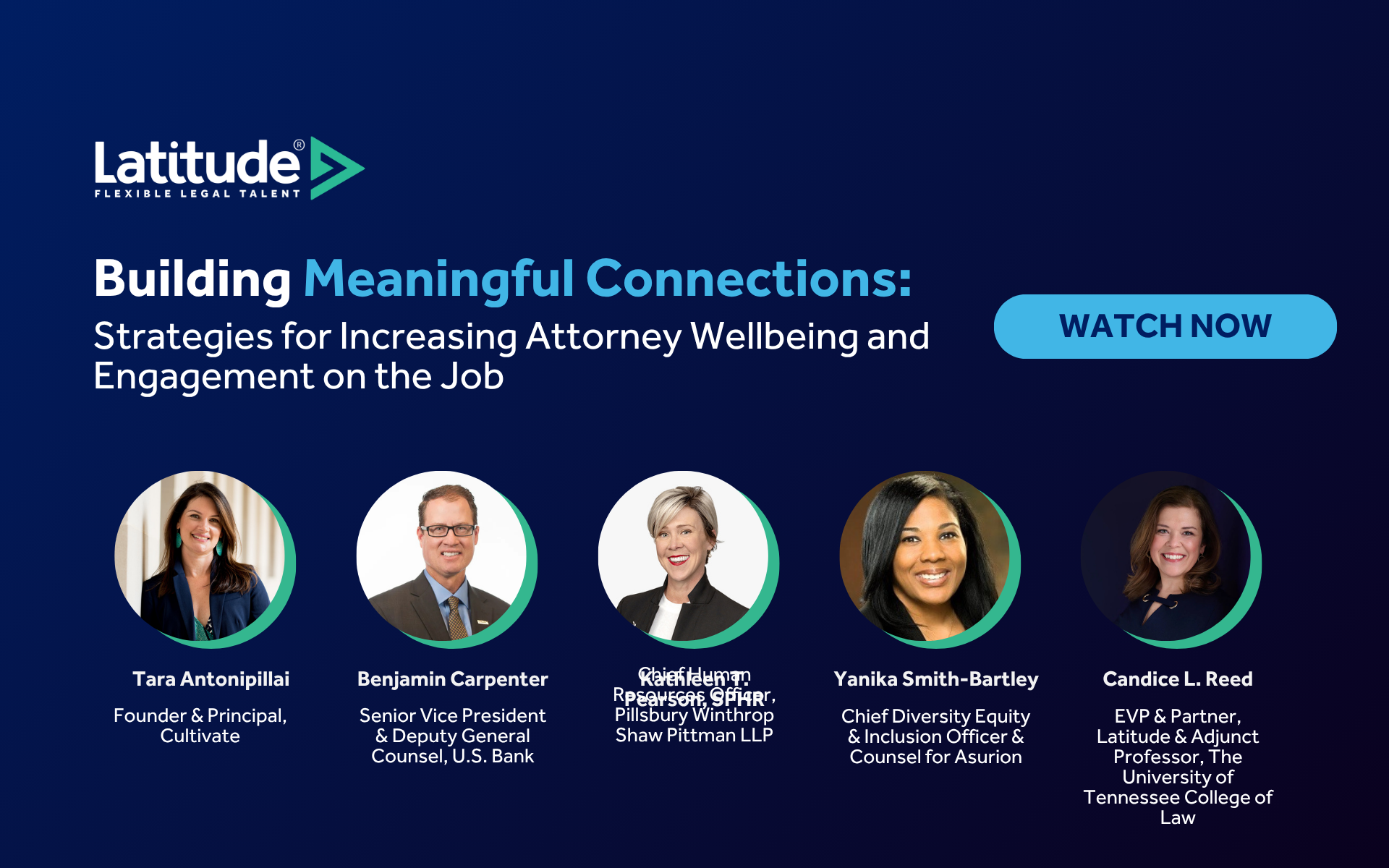
Welcome everyone. My name is Candace Reed and I have the good fortune of serving as your host, for this webinar and CLE today. Thank you for joining us. I’m noticing the numbers climb, so I’ll buy a little bit of time here at the beginning to make sure that everyone gets in and, can hear and see our speakers this morning. This is, the third or fourth year that we’ve done this particular, topic. The larger topic of attorney well-being is our year end CLE, and, it has proven to be a very popular one. So I appreciate all of you engaging, in the topic and with us and in this space. If you have questions throughout the webinar, please feel free to use the chat feature. While you may not be able to see, everyone’s questions, we can. And so I will be monitoring that chat box, and, we’ll be happy to pose your question to our panelists, within the next hour. So with all of that said, I would like to introduce you to our speakers today. And to do that, I am going to, show you to a a couple of slides, so that we can move quickly through the introductions, but I would encourage you, to look at all of our panelists’ LinkedIn profiles or the biographies that we’ve shared on the registration page as their credentials are quite impressive. So first, we have Cara Antoni Pillay. She is the founder and principal of Cultivate, a consulting firm that specializes in supporting and increasing attorneys’ well-being. Prior to starting this business, Tara was a tax lawyer in Arnold and Porter’s DC office. She also also serves as a member of the research and scholarship committee with the Institute for Well-being in the Law. Next, we have Ben Carpenter. Ben has over twenty five years of legal experience in the, financial industry and currently serves as senior vice president and deputy general counsel at US Bank in Minneapolis. He also is the corporate sponsor of the bank’s law division’s well well-being program, which we will discuss further, in just a few minutes. And next, we have Kathleen Pearson. Kathleen is the chief human resources officer for Pillsbury, Winthrop, Shaw, and Pittman. She is based in San Diego, California, and she is responsible for developing and executing human resource resource strategy, supporting the street strategic goals of the global law firm’s twenty one locations and over fourteen hundred partners and employees worldwide. Wide. And our final panelist today is Nikki Smith Bartley. Nikki is the chief diversity, equity, and inclusion officer and legal counsel, at Asurion based here in Nashville, Tennessee, which is also where I’m sitting. Nikki is responsible for embedding Asurion’s global DEI strategy into attracting, engaging, and developing talent, as well as being responsible for proactively assessing and building best in class employment compliance and wage and hour practices. And you’ll see there on the slide that under her leadership, Asurion has been recognized for its diversity and inclusion program, by multiple, well known, organizations. And then for those of you who may be wondering how in the world I got here and among this group, as I mentioned earlier, I’m the executive vice president with Latitude, which is a legal services company that, places former big law attorneys, in corporate legal departments and with, AmLaw two hundred firms nationwide. Now to center our conversation this morning, you know that we will be talking about well-being. I always like to refer back to this quote that was included in the path to lawyer well-being, from the ABA report of the national task force on lawyer well-being that came out in two thousand seventeen. There’s been an update to that report recently, which we will discuss in a little bit of detail later on. But here we see, we define lawyer well-being as a continuous process whereby lawyers seek to thrive in each of the following areas, emotional health, occupational pursuits, creative or intellectual endeavors, sense of spirituality and greater purpose in life, physical health, and social connections with others. The social connections with others is what we’re going to focus our conversation on today. But going back to the quote, lawyer well-being is part of the lawyer’s ethical duty of competence. So I want to start there and pose the question, to our panel. And, Tara, I’d love for you to to to kick us off. Why do you think, the ABA and lawyers generally should be concerned, about well-being? So from a from a competence perspective, I think it can come in in a couple of different ways. You you see it in, I guess, what I would describe as the more traditional ways, like substance misuse, which is, you know, on the rise. But there’s also, I think other aspects that come into the duty of competence that include things like prompt communication with clients and and, you know, other elements like that. You know, I personally think that an element of civility is, you know, it’s optional in most, jurisdictions in terms of compliance, but I think it’s also really important to about functioning, legal system. So, I mean, I think it comes in in a bunch of ways. And, you know, in some ways, it’s, I always hate to lead off with that aspect of it. Like, this is what that thing could happen, you know, if you don’t if you don’t take care of your well-being. But I think it is also it’s important, and it’s it’s also a way of opening up this conversation. So you mentioned the absence of well-being or the, I guess, the destruction of the absence of well-being. Ben, can you tell us, from your perspective, what are some of the, benefits of the presence of well-being, either, among your team in house or, among your outside counsel? Well, I think it’s very, you can see it. You really can. What we’ve tried to do at US Bank is develop programs and activities that not only provide people with opportunities to participate in behaviors that that promote well-being activities and things like that, but also engage with each other. I think that’s a big part of it is you wanna provide people with opportunities where they can see others and they can, you know, perform activities with each other, you know, not only in the legal, frame, but also, just, you know, social activities. We think that that’s a very important component, especially since the the compo the, pandemic, when there are fewer opportunities to really engage in a meaningful way. But we see that there, and we also see it with our outside counsel. We’re fortunate to have some outside firms who have sponsored activities where they will invite us to participate with them, and we get the same benefit from those as well. Kathleen, I’m assuming or guessing that as the leader of the well-being programs within your firm that you might often be asked to explain how well-being or the programs that you’re suggesting implementing hit the bottom line. Not not to just talk about the money, but I think it’s an important, part of the conversation. And so can you tell all of us how you answer that question? Yeah. That’s a great question, Candice. And I think, you know, when you look at well-being historically, you know, sometimes people think about it. Oh, that’s the fluffy HR stuff. Right? That’s that’s yoga. That’s meditation. I don’t really have time or inclination for that, but I really always try to leave with the business case for it. Because at the bottom, you know, at the end of the day, we are a business, right? And we’re trying to support our clients, such as Ben or, you know, other clients that we might have around the world. And in order to do that, we have to have healthy lawyers. So I view this as no different than any other type of benefit that we would offer that actually enhances the the the quality of life for our attorneys and our staff, making sure that people are well from a holistic perspective. So when you start to look at it on a business case, you start to see attrition rates being significantly affected with burnout and with mental health overwork, all those types of things, a lack of teamwork, a lack of connection, all of that social glue that I like to talk about in the HR space. All of that has a direct implication on mental health and well-being and making sure that you do have, you know, a focus on the bottom line and the implications of this. So again, it’s, it’s attrition, it’s, the quality of service that lawyers are providing to clients. You know, when you have a certain level, we only have we have a finite thinking, ability of time. So you’ve got to make sure that you you’re giving yourself that kind of rest and breaks so you can find the right solutions for clients and that you can work effectively as as teams. And so I think really it has to always start with the with the business case and the bottom line and looking at why we’re doing this in the first place. Then the conversation shifts away from it being, you know, about the things that they don’t really understand or maybe don’t don’t you know, that doesn’t necessarily resonate with them, but it the bottom line does. I I wanna stick with you for just a minute, Kathleen, because I know that Pillsbury has been a leader in the well-being space for a number of years now. That this isn’t something that you just started talking about, over the course of the pandemic, that you’ve been implementing, programs for many years to address attorney well-being. But it seems like the conversation has changed recently, or where you were twenty years ago isn’t necessarily where you are now. Can you talk about the evolution of both the conversation around well-being and also some of the ways in which, you may have once addressed it and how you’re addressing it now? Sure. And I hit on it a little bit before. Right? So twenty years ago, when we first started the well-being program, it really was much more focused on kind of what you would, you know, wellness and, you know, fitness challenges and all of that is important. But again, starting to think about well-being from a holistic perspective, whether you’re talking about financial well-being, mental health well-being, you know, nutritional well-being, all of those create a holistic approach and you have to sort of meet people where they are. And we started about five years ago, our focus really around mental health and started to switch a little bit more towards how do you make sure that you’re protecting, you know, the brains of our lawyers? How are you, how are we creating teams that can work effectively together? And how can we build training in that that enhances the ability for our folks to relate to one another and with clients? We don’t always get it right. And there’s lots of things that we still have to do yet, but part of it really starts with breaking down the stigma, and and creating that safe space for these conversations. And what I’ve noticed, the more we’ve sort of had these conversations and started to really have trainings with senior leadership. And it started with me meeting with the board saying, this is a really important thing that we need to focus on and talk about. And going back to the ABA study, Candace, that you mentioned in in twenty seventeen and the one that was recently updated, the numbers have gotten scarier and worse. So in twenty seventeen, one in eleven lawyers had suicidal ideation. This year, it’s one in five. So we’re going in in a very dark direction. And when you have those kinds of conversations with individuals and with leadership and risk management, you start to talk about, you know, why we need to have these conversations and get continuing to push that forward. And the more conversations that we’ve had and the more we’ve socialized this in a healthy way, the more people are actually raising their hands and talking about, you know, what what would it look like if I needed to go on a leave? How could I, you know, really, you know, before they might not have had that conversation, now it’s it’s starting to be more like, well, if you broke your leg, you would, of course, go to the hospital and you wouldn’t be working if you same should be true for your mental state your your mental health. If you if you break your brain, you should also give yourself the space and grace to get better, and there shouldn’t be a stigma tied to that. So I think breaking that stigma and continuing those conversations, we recently had all of our leadership team, including the chair of the firm go through mental health first aid training. And again, kind of creating that awareness that this is important and something that we need to value as a community and value as as individuals as we support one another. Listening to the first part of what you just said about, yoga, I’m reminded of Paula Davis, who is an author of a fabulous book called Beating Burnout at Work. She’s a former attorney who now, helps to support not just attorneys, but even soldiers in the in the US army. She trains them as well on, building resilience skills and battling against or, kind of buffering against burnout. And, we had the opportunity to talk on a podcast, last year, and I still remember her saying something along the lines of you can’t address burnout with yoga and fruit plates. Like, the those two things both are important and, can do good, especially if you’re partaking of them, on on a regular basis. But in and of it themselves, that is not going to, curb the tide, that we’re seeing in terms of attorney or attorney’s lack of well-being. So thank you for mentioning that. Nikki, let’s turn now to the idea of relationships and, how relationships impact our well-being, particularly at work. In your role, what have you seen, or what do you believe are the necessary ingredients for kinda creating the space, where you can cultivate positive relationships at work? Yeah. And so, I I believe that, first of all, hi to everyone out there. I’ll say that first. But I think the pandemic really showed us. Like, in in the diversity space, there’s this cliche of, you you know, diversity is about bringing your full self to work. Right? Being able to bring your whole self to work. And I call it cliche because some of it, you you you need to leave at home. You can’t bring all of it, but bring your best professional self to work. Right? And I think we saw more of each other, you know, in the pandemic by being in our homes and working in our homes. Right? And so that opened up the conversation about, okay. Even if I’m not supposed to you know? Before, it was like taboo, you know, to talk about, you know, your home life, but it became necessary to have those conversations to talk about your home life. And so in order to have those conversations, it’s important to create that safe space that Kathleen was talking about. And so one of the things that we’ve done, we are starting to we’ve rolled out, creating a safe space, and it is all about psychological safety. And what we’ve learned in the sessions that we’ve held is that people are saying that’s what it is. Like, I didn’t know how to label it. I didn’t know what to call it, but it really is about leaders and peers creating that psychological safety and that safe space to have those meaningful conversations so that you can have those positive relationships. And so I think, well-being is tied to having those positive relationships in the workplace. Positive relationships in the workplace cannot be fostered without creating that safe space, which is psychological safety. And so some of the things that we’ve done in the past even before the pandemic and going forward is that, you know, it is often, taboo to talk about certain topics in the workplace. We have what we call be bold conversations, and it really is about talking about getting comfortable with talking about the uncomfortable topics in the workplace. And so by having those conversations in the workplace, whether it be on me too or taking a knee or LGBT inclusion or religious inclusion, having those conversation, they open up the door for folks to really feel comfortable about having conversations that are typically uncomfortable or typically taboo in the workplace. And that opens up, I believe, transformative conversations in the workplace, helps breed inclusion, helps to create those and foster those positive working relationships. One, of our attendees commented, that they wonder, whether some of the well-being statistics have decreased because we are now having these conversations, and we are creating safe spaces where people can say, hey. It’s me. I’m the I’m the one that’s struggling, you know, or I I’m I’m the one in seven who desperately needs help. And I think there’s probably some validity in that, that it’s no longer taboo like, Kathleen mentioned. And as you mentioned, Nikki, we are starting to create safe spaces where, people can raise their hands and say, yeah. That’s me, and I need help. Tara, before we go too far into the the conversation about relationships and fostering better connections with both our team and our clients, can you give us some of the science that backs up everything we’re saying today or at least backs up the purpose for having this conversation? What do relationships have to do with well-being? Sure. Well, I I look at it as really twofold, kind of on a personal level, on a professional level. What we see is that relationships are extremely predictive for both physical and mental health, but also for professional kind of success or what you might call professional well-being, job satisfaction, engagement, things like that. So, for example, there is a, longitudinal study out of Harvard now, and it’s second generation that follows, a group of individuals throughout their life. And what they found in this study is that, positive relationships, so those can come in any form. It’s basically defined as, you know, someone you can call in an emergency. Those were more predictive than things like high blood pressure than heart disease when it came to than smoking when it came to longevity. So, you know, they have that that impact on physical health. What we generally find in society is that those types of relationships are sliding, so people have fewer of those types of people in their lives than they did twenty years ago. And then on the professional side, well-being is, relationships are really critical to well-being. There was a, study done, on lawyer. I mean, it was called lawyer happiness, but, really, it was lawyer, well-being and job satisfaction that was measured saying that the the three most important things are autonomy, mastery, and relatedness, relatedness being the one that that lawyers tended to to struggle with the most even though it was the most directly tied to things like job satisfaction and, performance. So I think it’s really critical whether you’re thinking about it, you know, for on a personal level or a professional level. I don’t know if you recently saw the surgeon general’s recommendations that just came out, but community and connection was the number one thing on the list for a thriving workplace. And so I think we’ll really see that start to be more, important and more of a focus, particularly as we kind of settle into this hybrid workspace. Yeah. The the surgeon general actually has a a really insightful book that came out, I believe, in twenty twenty. Perfect timing to talk about together, which was the name of the book, and it was about, some of the research and conversations that he had had when he was, the when he was previously the surgeon general in the, Barack Obama administration. But, I would encourage you to to read that book. There is a section on lawyers, specifically, that that where he talks about, our, profession and how we have, risen to the top in terms of the loneliest profession in, in the country. So, I’m sure we could go down a rabbit hole, the talking about why that is or why that might be, coming forward in certain studies. But because we are slightly limited on time today, we’ll leave those musings, for the, for the break room, or for your holiday party, and, and and get to some of the the, strategies that we know, to work. So, Ben, you lead a team of people, in house as well as a, many other teams, I’m sure, across the country when it comes to, your outside counsel. How did you get to this outside counsel. How did you get to this conversation, or how did you get to the point, where you were discussing well-being and relationships? And what did you and US Bank, choose to to do in the space? Yeah. Well, it was a bit of an experiment. Last year, you know, after having developed our program and, worked with our internal people to understand the importance of well-being, we really wanted to do something with our law firms. We spend all day every day either working as lawyers for our internal clients or working as clients for our out with our outside law firms. And kinda like we were talking about before, you can do only so much, you know, yoga, food, play, meditation. I mean, if your whole day is consumed with these relationships, if those relationships are not productive and constructive and supportive, you know, it it doesn’t do much good in terms of well-being. And and we really view this as an industry thing, and we wanted to see what we could do, to, influence, not only our own teams, but our outside teams. So what we did is we invited seven firms to get together and just laid out the question, how can we work together to promote well-being? And, ultimately, over the course of, several months, we came up with these set of guidelines. And the guidelines are intended to just provide some very flexible, ideas for how we can interact in a way that supports well-being or doesn’t, you know, produce, you know, behaviors that that, that negatively affect well-being. So it’s just a it’s a one page thing. You know, and what we tried to do was just say, you know, if you’re if you’re, going to have an engagement, talk about your your work schedules, talk about communication. I mean, kinda like Nikki said, I mean, it it was designed to create this conversation, create a space where we can have this conversation at the outset, which is not an unnatural conversation. It it might seem so in the legal context, but this is how people interact. Right? I mean, what do you what do you like? How do you like to talk to me? Do you like emails? Do you like this? You know, all that kind of stuff. So we wanted to create a safe space for that conversation. And we wanted to set the expectation that, hey. As a client, this is what we want from our outside law firms because we recognize a couple of things. One, you know, this is an industry issue, and we want everybody to be participating in, activities that promote well-being. But also, you know, I mean, results matter clearly, and we want the best lawyers working on our stuff. Like Kathleen said, if if your firm is suffering from attrition or just, you know, issues with, you know, not getting enough sleep or, you know, whatever it is. You know, those lawyers are not gonna produce the best results for US Bank. So we wanted to really tackle that. And what we found through those guidelines, what we did is just implement them very softly with our seven firms that do US Bank matters, is that people started to make small changes that really really made a big difference. So none of this stuff was dramatic. Right? We’re just talking about having conversations. But what we got out of it are a bunch of little stories where somebody said, hey you know thank you for contacting me you know this isn’t urgent so don’t treat it as urgent or I’m on vacation right now is it okay you know somebody else handles it and what it did is I mean certainly some things are urgent and you need to treat them as urgent but there are a lot of things that are not urgent and we don’t want to treat them as urgent and so we need to communicate more effectively about, hey, this isn’t urgent. You don’t need to get this thing first thing Monday morning. Tuesday is fine. Right? I mean, most stuff is of a non urgent nature and so just having that conversation just led to all sorts of great stories about people just communicating more effectively and ultimately building better relationships with each other. I I I wanna highlight what I what I think I heard you say because I bet a lot of people who are listening, would appreciate you repeating. But, you you you talk about kind of this culture of racing to respond. And I heard you say that as the client, that’s not necessarily what you want. Is is that correct? Did I hear that correctly? You gotta be real careful with that one. Yeah. But that that is right. I mean and, you know, when we were talking to our law firms, it wasn’t only well-being experts and development experts. It was also the practitioners. So they gave us a bit of dose of reality. And one thing that we have to accept is responsiveness is a cornerstone of the legal profession. And, you know, firms often compete on responsiveness. You know, firms will will try to impress clients with responsiveness. But what we wanted to do is say, okay, there are times when we need you to get back to us, but there are also times when, you know, if we communicate to you we don’t need something for three days, we don’t want it six six AM the next morning. So you have to honor the fact that it’s not an urgent matter, so we don’t want you waking somebody up to perform that work for us. We want somebody who’s in good shape, has their mind, you know, in a great spot working on our matters. So you know we don’t want to compromise the quality of the work just for responsiveness, but you know that it’s a real thing. I mean you know I do expect lawyers working on my cases to be responsive, but for example another issue that we ran into is somebody’s on vacation you know they they said you know I still want to be the person you contact I am your lawyer I want you to contact me with anything at any time I’m always on and we said you know that’s not exactly what we want if something isn’t urgent if we don’t need to contact you designate somebody else we’ll work with them and that’ll give them a little bit more visibility that that you know we can, you know, work on, you know, we can work with other people, give them opportunities, to to show us, you know, their abilities and things like that. So it opens up opportunities when we say, hey. Listen. You don’t have to be the person all the time. Let’s have a team. Let’s have a diverse team. Let’s have a team, you know, with with with, you know, great expertise in a lot of different areas. So so this kind of, you know, has has, you know, sort of a collateral impact of helping, you know, other people get the opportunities to work with the client that maybe they wouldn’t have had if the managing partner insists on being the one and only contact. I I love that idea that, by by not falling on your sword or by not being completely available twenty four seven and always the person that you’re allowing other people an opportunity to to grow professionally, to build connections with the client in this case, and to do better work too. It’s like you’re nurturing their professional development by being inclusive and bringing them in, to the to the conversation. Kathleen, I suspect that, you well, I don’t suspect. I know that your firm is tasked, you know, with training up a bunch of new lawyers every year. How are you injecting some of what Ben has said into your training of new lawyers? Yeah. Great question. And, you know, to Ben’s point about the speed of work and the speed of practice, I think it can’t be, overlooked at all as as it with regards to mental health and well-being. So I spoke with a a senior partner in this. This is gonna answer the question, but I wanna give a little background for how we how we sort of build in some of this into our training. I talked to one of our senior lawyers, you know, several years ago and asked what the difference is in practice now. You know, what what really has changed? And and without even pausing, he said this. Right? It’s these it’s these devices, and it’s time. You know, he said early in my career, back in the day before, you know, we had this instantaneous communication. When a client called with a problem, you would maybe talk it over on the phone, they draft some documents and mail it, put it in the mail and send it. And it might take a week to get to Ben all the way across the country from San Diego. During that time, we may have had some more conversations. Maybe new things had come up. You know, our approach might have changed. But that time was there to really think. Again, this is a thinking person sport. And and this expectation with with computers and phones and constantly being, you know, on call and constantly needing to feel like you need to respond immediately is taken time away, exponentially and and create increase stress. And when you look at the workforce and we think about a training plan, and if you continue to train people the way you were trained previously when you had the gift of time, those that no longer works because the the the emerging talent that’s coming up through the ranks right now are digital natives. They’ve never ever not been connected. Think about that for a second. The junior associates working either on your matters or in your firms have never not had a cell phone. They’ve never not had complete one hundred percent twenty four seven connectivity with, you know, either their families or their work or whatever. So they don’t know how to how to build boundaries. Those of us of a certain age do because we remember a time when you could walk out the door and not have access to your email. So when you think about mental health and training and how we’re raising this next generation of lawyers and this apprentice model, we need to be intentional with teaching them a skill that doesn’t come naturally to them. Like, they you say you need to build in boundaries, but we’re not teaching them how to do that. And then I think your, you know, your program really takes that, you know, the step that it needs to take. This needs to be driven as a conversation with clients to sort of say, let’s have a conversation about responsiveness. Yes. We want you to be responsive, But there’s a point to that too. Like, we need to be careful with that. But I think, you know, when you’re thinking about training programs, really building in those kinds of understanding about what boundaries mean and how to ask for them. Right? How to say, it’s not it’s not saying that I don’t wanna work. It’s saying that I wanna eat dinner. I wanna be able to put my phone down for just a minute. You know, when the pandemic happened, I had a, a conversation with an associate in one of our offices who was really at the point of burnout, really stressed out, and, you know, we were talking about what the working situation was like. They were trapped in, their their very small apartment. They couldn’t go anywhere. They were in New York City, so that really that was during the height of the pandemic. And I said, where is your computer? And they said, well, it’s in my bedroom. I said, so when you go to sleep at night, the black box of doom is looking at you. Right? That’s not good. So when you roll over, it’s there. You know, how do you create that kind of boundary? Put it somewhere else. Try to find a way that you can put it down. They said, well, I can’t. What if my partners need something? I was like, then create a space and have a conversation with what that expectation is because it shouldn’t be every day at three AM you’re rolling over and looking at your computer. Yeah. Absolutely. And some of us, I think, who, grew up in large firms, or who had, that large firm experience where we might have been expected to respond, at at all hours of the of the day at night. I’m not saying that that was the expectation that my partners put on me, but, I’m just lumping myself into to that collective. But, to some extent, I think that it it requires those of us of as a of a certain age, as you said, to recognize that we also need to set boundaries, as well so that we can then model that behavior, for our younger associates, and and and help them see that it that it is okay. I wanna talk about another skill that I have heard a number of, people talk about has been impacted by technology or our heavy reliance on technology, and that is empathy. And, you could probably throw in a a few other skills that kinda circle around, empathy as well. But I’m curious, Nikki, where where do you think that has gone? Or if it has gone, you you know, maybe it’s just me and my crowd, that that are talking about that. But do you think that is something, that, we might need a little more of, within our teams or certainly something that might, help support better relationships. So I’m gonna say at the outset that I’m biased because if you if you haven’t done strength finders, you should do it because it’s a really neat tool. And my number one strength is empathy. So I definitely think that there there’s a need for it. My number two is achiever, so they fight each other, but that’s another story. But a Gartner recently did a a survey on what employees are looking for. And what they are looking for is often from a leader is authenticity, empathy, and flexibility. And in order to be a great leader, I think you need a a good mix of all three of those. And so it makes sense that that’s what the survey reveals. And during the pandemic, I think it was especially important, for me to be all three of those, for my team because there were many situations where, you know, we’re just working differently in the pandemic with our you know, some were teaching their children, you know, working in the same space with their husbands or spouses or partners or whatever the case may be. And so we had to work differently. We had to work differently. And so I made it a point to be vulnerable, you know, during that time to say, okay. I’m having a bad day, whether it be because, you know, I’m teaching third grade and kindergarten or because it was the murder of George Floyd or because, you know, I didn’t get sleep, last night. Right? So I model that for my employees so that I can create that safe space for them to say, okay. Yeah. It it’s rough for me too. In in terms of empathy, I make it a point to to tell them, like, if if there’s a meeting and and a perfect example, just yesterday, I tried to fit in a meeting with one of my employees. And she said, well, I’ll is it okay if I’m not on camera? Because I am driving I’ll be driving my daughter to a counseling appointment during during that time. That’s my drive time. I said, let me cancel it, and we can we can touch base. It’s informed. We can touch base at a time more convenient to you. Because I want them to know that, like, I’m I’m not here to take up your your your drive time with your daughter on on the way to a counseling session. And so modeling that flexibility, that humanity, you know, for your employees gives them you know, creates a safe space for them to say, hey. I need a mental health day. Or, hey. Can we move this meeting back because I have x going on? Or when I open up the conversation to talk about the murder of George Floyd or whatever else hits the the headlines that has our hearts, you know, that are pulling in our hearts and say, hey. This I’m having a rough day because of what I saw on the news and open up the space for us to have crying sessions because that has happened in the workplace. It gives them the opportunity to do the same with their teams and to know that they can do it with me. And I think as a result, I had no attrition during the pandemic. Like, all of my employees stayed because I and I believe it’s because we created that safe space. And we’ve also taken steps to to, advertise tools that are built into, like, Microsoft tools. So and there’s a tool called Microsoft Viva. Right? And it will tell it will analyze all your meetings, and it will tell you, like, you spend this percentage of your time, on emails after work hours, or you you were multitasking during a meet during a meeting. It will schedule focus time for you on your calendar so that you have an opportunity, you know, in between meetings to actually do the work that you’ve been assigned, during the meeting. Another one I think most people know about just, you know, Outlook, you can delay replies. Right? You can delay sending the email rather. And so instead of sending the email when it come like, you might wanna get it off your to do list. Right? And you might be working at six o’clock, but you don’t want your team to feel compelled to respond because it comes in at six o’clock. And so delay that email and, you know, until the morning. And so those are things that, you know, we are implementing. It’s all about those boundaries that, you know, Kathleen was talking about, but just giving, you know, your employees permission to set those boundaries and and to be human. Those are great, suggestions. It’s interesting to hear you talk about how it became so critical for for for many of us to show up to work authentically during the pandemic, or maybe critical is the wrong word. There was, like, no other option. Right? Because for so many of us, we this was my experience. Because we were in our homes or in our home offices, it was easier to show up as our whole selves, because, we had already kind of broken one boundary by the space that we were inhabiting, to together. I’d like to throw this question out to the whole panel and say, what have you done or what have you seen work that helps nurture positive relationships at work? And that can be either in the same when we were working in the same physical space or when we are working as part of dispersed teams that may only be connecting on a regular basis via a computer screen. And I’ll start. If you’re looking for a really simple or quick, suggestion, which sometimes those are the easiest ones to implement, right, especially in the midst of a busy holiday season. I remember when I was an associate at a large firm, my managing partner came to me one night and said because, of course, I was working late, but he was too. And he said, you need to go out to lunch more. He was like, you know, you need to physically leave your office at least for thirty to forty five minutes a day and eat lunch. And he said, not just because you need that break from your computer or from, you know, the mental break from the the work, the, you know, physical movement and just walking around the block will be helpful, he said, but it will help you connect with more people. He was like, that’s how you start to build a practice. You know, it’s by, inviting someone, not necessarily someone from the firm, but someone to go have lunch with or, you know, go to a popular lunch spot and see people. And that was, such a great piece of advice for me because I think it helped me see the value of relationships very early on in my practice. So it wasn’t just a mental break for me. I was getting energy from being around other people, and then that also led to other things like, you know, business development opportunities later in my practice, etcetera. So, again, I’ll throw it out to all of you. What are some of the things that you have seen work? What would you suggest to people who are listening, and watching and wanting some pragmatic advice on where to start? Do you want me to start? Sure. Tara, you start. I’ll start. So the thing that I that helped me when I was working that as a lawyer, that helps me now, and that I really focus on a lot when I teach workshops on this is it’s something that sort of in the literature called task enabling, but I can think of I think of it as giving or getting help. Right? So you’re really looking to connect with someone by asking them to help you or by helping someone else sort of shine. There’s a great video that I can’t put in the link right now, but if you Google Mo Cheeks national anthem, you’ll see, like, this really great example of task enabling. And it is also, I think you know, my when I was young, my husband always grew up in a family where everyone asked everyone else for favors. And he would say, well, why don’t we get all our friends together and they’ll help us move? And I was like, that sounds terrible. We should just hire a moving company. No one will want to do that. And he said, yeah. But that’s how people become closer, right, is by asking each other to help. And I and I I think the literature really supports that. My experience supports that. And I think it’s something that people can do that’s a little bit more authentic than starting a meeting and saying, like, oh, let’s everybody go around and tell something about themselves. Right? Because, you know, if you’re a junior associate, you can call someone and say, like, you know, I’d really love to hear the story of how you, you know, became a partner or people like to be asked for that kind of help generally. And I did not learn that until I was much older. And I think the giving and receiving of help, particularly in a hybrid world, can be a real a real bonding, time. So I’ll drop in right after that. I think, you know, I I love that kind of notion of storytelling. Right? And I and I’ve also, what resonated is hearing Nikki talk about empathy. During the pandemic, we had, you know, obviously, we’re all at home. And then when George Floyd was murdered, we recognized that was really impacting a very large group of our our population that really needed some connection that we were missing. And if we had been in the offices, we would have had, the opportunity to come together as a community and and have, you know, lunches together or talk through things. And that was missing. So we decided to do, what we call shared experience forums around, George Floyd’s murder and or it was led by our DE and I chair. And, you know, we first post this to the chair of the firm, and he was like, I’m not so sure about that. Like, how can I solve this? Right? He was in problem solving mode, which is great. He’s a wonderful, empathetic leader, but that was very uncomfortable for him to sort of say, so you wanna invite the entire firm on a Zoom call, and you wanna talk about George Floyd’s murder. What what am I gonna do? How can what if somebody asks something, or what if somebody says something that’s uncomfortable, or what am I what problem am I solving is really what he was asking. And we said, no. This you need to take your problem solving hat off and put your empathy hat on. And this is when we need to share stories together and hear our colleagues and say it, you know, we just hear you, and we’re here in community together. And, you know, I still get, you know, goosebumps thinking about this meeting we had. Well, over nine hundred people worldwide join this Zoom call, and we had colleagues sharing story after story after story of pain that they’ve been feeling of either from George Floyd or from experiences that they had individually. And there wasn’t a dry eye. And and again, when we left that, it was an hour and a half. We went way over, because people were just sharing and they needed that outlet. And once we had done that, we realized that we did have this great opportunity to be vulnerable with one another and share. And I think it profoundly changed the way people interacted with one another, and it it it sort of opened that door to when someone asks you that question, how are you today? That the automatic answer doesn’t have to be fine. Like, it can be you know, today’s kind of a rough one. And I’m not trying to you know, nobody needs to try to solve that problem for me. It’s just taking that gas out just a little bit and saying, I see you. I hear you. And maybe I can I can help shoulder the burden a little bit? So I think all that is something that I’ve really learned over the past. You know, how important that really that empathy, that storytelling, and that vulnerability is with one another. I would piggyback on that, in that it is necessary. I know we especially as lawyers, like, we get afraid, you know, we become afraid to have those conversations that may, like, cross the line, right, or someone may get offended. But there is a there’s a difference between that and ignoring things that need to be addressed. Right? And so it is creating that space, those forums to have those conversations so we don’t look so leaders don’t look like they’re, you know, they’re under a rock. You know? It’s like, am I supposed to act like everything is okay when all of this is going on? In addition to the George Floyd, we had forums for George Floyd. We partner with our, mental health advocate, Lyra, to help us host those sessions. But also, with the Dobbs decision, there was concern, me in particular. I had concern as a lawyer about having a forum where we could discuss this. Right? Because it’s polarizing. There are, you know, there are many sides, you know, to, to that topic, but we created a space to have that discussion. Everyone was professional, and we had a professional conversation, and we were thanked for having you know, providing the space to have that conversation. So I think that’s one. I think two is active listening. And so we’re all you know, we have two ears and one mouth for a reason, but it’s hard sometimes where you’re trying to jump in, you know, to make your point or to add value. But I think if we really actively listen to each other, that that will help to build those relationships. And then three, I make it a point, especially with my direct reports, like, one on ones are sacred. I keep them sacred. I make sure that I am every week, I am talking to my employees and making sure I know where they are, how they feel, what’s going on. And so those would be my opinion. Those are all great ideas. I you know, one one thing that that comes out of that is is I don’t think that this that there are simple tips and tricks that they’re gonna do it. It it’s creating a culture because where you need to start to have those conversations is people need to understand people need to be human. They they need to have they need to trust their leaders, you know, and so you need to create a relationship that facilitates these discussions. And I think that, you know, through the pandemic, we’ve had all sorts of opportunities to say we don’t know the answer, and we know everybody’s situation is different. And, you know, I mean, George Floyd happened in our backyard here at Minneapolis. I mean, you know, that was a challenging time, and we were very clear from the top down. We don’t have the answers, and we certainly don’t know how to speak for everybody on this. So let’s open it up. Let’s recognize the fact that we’re all human. You know, this affects us in very, very different, but but profound ways, and let’s talk about it. And let’s figure out how to move on, but not move on too quickly. We do need to address this. We do need to get through it. We’re not gonna just put it in the in the rear view window as soon as possible. So I I think that there are a lot of ways we we can do it. I I think that opening meetings with what’s on your mind. You know, let’s set the stage for people to just say, you know, my kids are this or, you know, that just creates an environment where people recognize that we’re all human. And now that we’re doing it on video, you can see their natural habitat. That facilitates it as well. But, you know, I think it’s a it’s a it’s an all ongoing everyday thing, you know, and and creating opportunities where maybe you can go do a, a, a charity event together. I think that that’s really, really wonderful team building kind of stuff. So so we’ll do things with Feed My Starving Children, other, you know, areas, and and people people love to do that because they wanna be helpful and they wanna do it with their colleagues and they wanna build those relationships. So just creating a culture where that’s the norm, I think, is the most important thing. Thank you for all of those suggestions. I hearing each of you talk and and, Ben, your comment about creating a culture reminds me, of a study I saw, within the last year, I think, where, it it the conclusion was that people with at least one best friend at work are less likely to leave. And, to piggyback on that, just yesterday as we were all preparing for this conversation today, I saw, you know, some quote from, Brene Brown, the social psychologist who said that our our connection with other people can be centering in times of extreme stress or change or unknowing. And that, by focusing on our responsibilities to another person or to multiple other people, that can kinda give us a road map on, okay, what’s next? What’s the next step? And it it it made me think about the beginning of the pandemic. And I know we’ve talked about that a lot, and everyone’s really tired of talking about that. But I feel like if we don’t at least take lessons that we learned from the pandemic, then it becomes an even darker time. And so one of the lessons that, that I took was basically what Brene Brown said because I was reminded that in the beginning of the pandemic, my focus became very narrow, and that was keeping my loved ones safe. Right? And so I knew what I needed to do every day because my my responsibility to them guided my actions or centered me, and it helped, some of the nerves dissipate because I was like, okay. This is what I’m able to do or control, and so this is what I’m gonna focus on. We have two minutes, before we conclude, which I know is not a lot, but, I’d would like to leave it with you, the experts and the practitioners of, building positive relationships and ask what is the most important takeaway? Kathleen, I’ll start with you. Wow. So the I I think that, you know, the most important takeaway to me is we have got to lean on one another and continue to build community. The things that I talk about within my own organization really are, you know, kind of the social glue that holds us all together or our relationships. Have we proven that the entire legal industry can work remotely? Yes, we have. Did anybody think that was humanly possible if we’re really honest? No. On March thirteenth, when we all went home, I think everyone was sort of taking a deep collective breath of, oh my gosh, how are we gonna possibly do this? And we did. Everyone picked up. I think, you know, the legal industry and lawyers are extraordinarily resilient, kept things moving, kept doing things for client, and worked worked remotely. But what we’ve missed is the blue factor, which is relationships. This is a people sport. This is a relationship based sport. And this is something that that, you know, we can’t we can’t just stay in a hidey hole, while lawyers tend to be, I think, Candace, she said, very isolated and very you know, it it is a lonely profession because there tends to be more of of an individual focus. The more we can get back together and build that community back, the better people will be and the better our organizations will be and the better work we can do with and for clients will be. Let’s see. Tara, let’s go next to you. Sure. Parting words. Sure. Mine is very, very simple. My word when it comes to relationships in twenty twenty three is intentionality. Whether it’s thirty seconds or sixty seconds or whatever it is, like, thinking about how we’re gonna do this as we kinda climb out of COVID and settle into hybrid, it’s gonna look a little bit different. So I think thinking about how we can intentionally build relationships in twenty twenty three is really the key for me. Ben, what about you? Well, I think we should all continue to hold ourselves, accountable for our own individual well-being, but we should focus more on the collective well-being, of the industry. You know, this this is an industry problem. I think we need to work together to attack it. Agreed. Nikki, you’re gonna close this out, today. So, what would be your, parting words of advice? So first, ditto to all that the other panelists have said, but I I would also add that we just have to address it from address it from a holistic and inclusive manner. We’re gonna, the world is gonna continue to turn and continue to change, and we just have to continue to be mindful of the whole self of of lawyers and our employees and making sure that we continue to address, needs from a mental, well-being standpoint as well. Absolutely. Well, thank you all so very much for sharing your expertise and your experiences. I appreciate your time. Thank you to everyone who was watching. We will follow-up with a an email that includes, links and, citations to some of the resources that we mentioned during the conversation today. And I wish all of you the very happiest of holidays and a great, hopefully, twenty twenty three. Thank you all.