“ESG is moving fast, and we are all focused on skating to where the puck is going to be.” – Jim Kerr, Southern Company
“ESG today is not what it was yesterday. It’s not what it’s going to be tomorrow. It’s rapidly changing.” – Bill Ide, Akerman
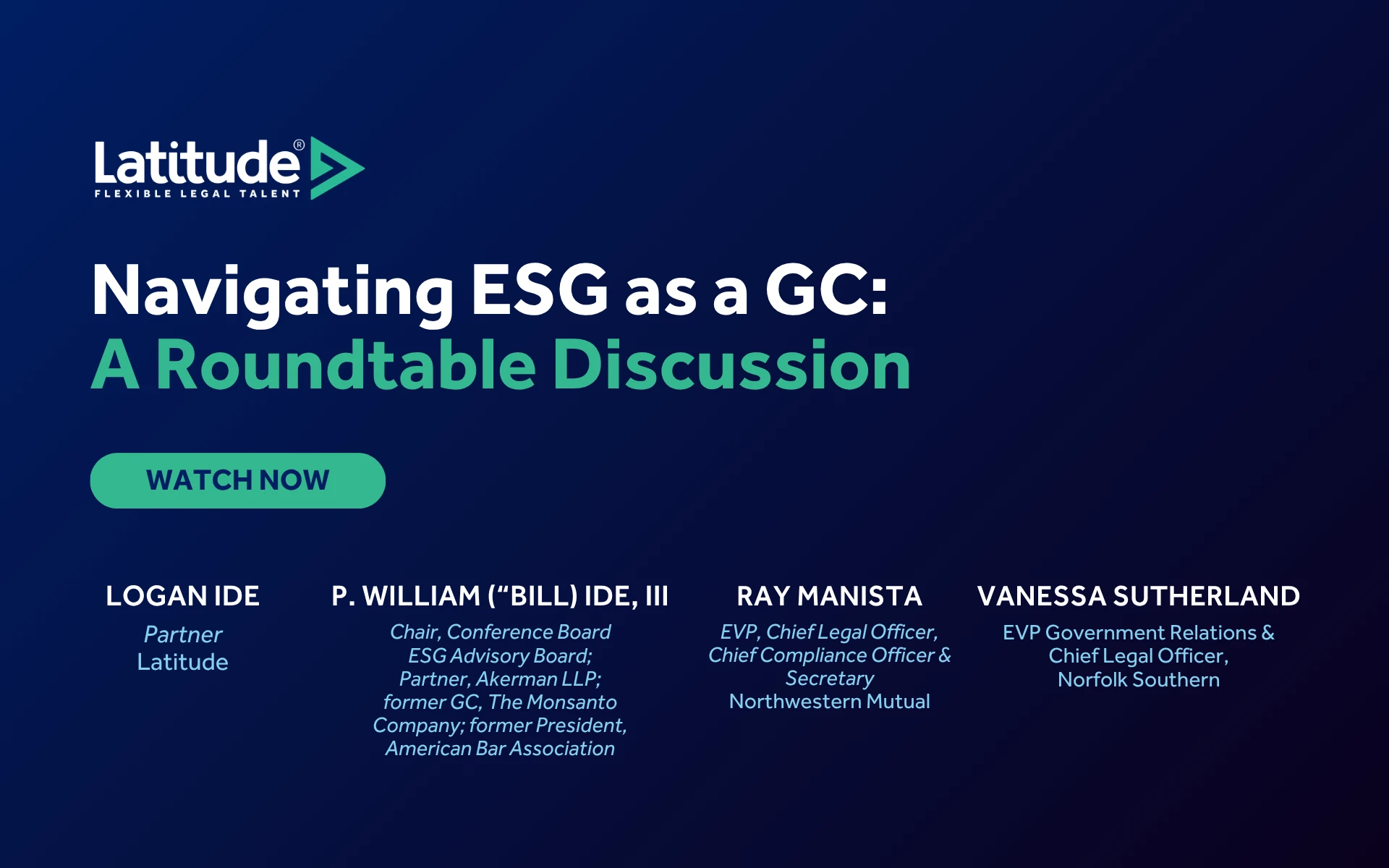
Latitude partner, Logan Ide, recently hosted “Navigating ESG as a GC: A Roundtable Discussion” with three well-respected general counsels – Jim Kerr, Chief Legal Officer at Southern Company; Ray Manista, Chief Legal Officer at Northwestern Mutual; and Vanessa Allen Sutherland, Chief Legal Officer at Norfolk Southern Corporation.
William (“Bill”) Ide joined us as moderator. Bill is a Partner at Akerman LLP as well as Co-Chairman of The Conference Board ESG Center Advisory Board. He is also the former General Counsel of the Monsanto Company and former President of the American Bar Association.
The panel had a wide-ranging discussion that illuminated the bigger picture of what leading companies are doing in the ESG space and drilled down into the general counsel role.
ESG as Business Imperative
Those of us outside of larger legal departments and investment management companies may not appreciate the magnitude and growing pace of ESG activities within leading companies. Jim Kerr provided the starkest example, describing how in the past five years Southern Company has made the determination that the company’s ability to attract capital and to manage its business is inherently tied to how they respond to climate change concerns. As a result, they have embraced a “carbon net neutral by 2050” business plan and redefined an existential challenge as a growth opportunity.
Bill Ide pointed out – with agreement all around – that, regardless of whether they are large greenhouse gas emitters, all businesses will be held to account by their stakeholders on their response to climate change and their activities in (S)ocial and (G)overnance areas, as well. Ray Manista backed this up by describing how – even as a private financial company – Northwestern Mutual has become very intentional about their environmental footprint, development of their human capital, and their impact on the communities in which they operate.
Vanessa Sutherland made clear that a wide variety of stakeholders, including investors, customers, employees, governmental agencies, and the communities in which they operate, are all engaging with Norfolk Southern on its ESG efforts and that being pro-active in activity and communication is the only real option for successful navigation of ESG.
Relevance and Role of the General Counsel
Vanessa stated that “ESG is a good opportunity for the general counsel to contribute and provide leadership based on their experience with governance and enterprise risk management.” Ray added that the GC is “uniquely positioned to herd the cats…based on a job that is fundamentally connecting dots across the enterprise.”
This enterprise coordination may include working with the board, internal audit, investor relations, compliance, finance, environmental, and M&A, among others. Jim shared that driving vertical coordination has become a new priority, ensuring that operating units are integrated with the goals and communications priorities of the enterprise.
The group agreed that the GC increasingly has a role in coordinating, validating, and participating in dialogue with internal and external stakeholders, including “relentless shareholder outreach” as described by Jim. In particular, the legal department must lead in ensuring that communications across the enterprise are accurate, consistent, and in line with company goals and regulatory constraints.
Looking Forward
The panel was unanimous in believing that the pace of ESG action, disclosure, and communication – and demands on legal departments – will only increase. Government regulation (SEC and otherwise) will play a role, but the momentum is primarily being driven by investors, customers (consumers and business), and employees.
One of the greatest challenges is in determining what information to disclose and report and how to do so. Ideally, investors (led by BlackRock and State Street in the U.S.), regulators (S.E.C.), and industry groups will be successful in consolidating and standardizing disclosure regimes. Jim described work being done internally and with consultants to try and be ahead of the curve in generating “investment grade, non-financial data” to satisfy coming regulation, investors and to minimize exposure to lawsuits alleging inaccurate disclosure.
Noting the current results of the 2021 Edelman Trust Barometer that put business as significantly more trusted than government or the media – as well as the highly polarized state of politics in the U.S., Bill asked what the role of the corporate enterprise should be. The panel shared that their enterprises view their roles as serving their shareholders and other stakeholders. That means building long-term enterprise value, mitigating risk, attracting and retaining employees, and being responsive to customers. When approaching challenging social and quasi-political issues, they lean into their established corporate values and try to ensure consistency in talk and action – “our audio must match our video.”
Hour amongst weeds in that in that slide. What a what an appropriate spring metaphor. Good morning. Good morning. Time to get started. Sorry. There we go. Welcome to, Navigating ESG as a General Counsel, a roundtable discussion. I’m Logan Ida, partner with Latitude. I’m glad you are all with us today and hope you enjoy the session. I have a few housekeeping items to run through, tee this up, and turn it over to our exceptional panel and moderator. This webinar has been approved for CLE credit in Georgia, Tennessee, and Wisconsin. You will all receive a follow-up email after the event. And if you complete the form, we will submit for you in Georgia and Tennessee or provide you a certificate for direct submission in Wisconsin and other states. We have the q and a function turned on and encourage you to ask questions. We’ll try to get to those during the course of the presentation and reserve time at the end as well. The webinar is being recorded and is planned to be available for future viewing, including for CLE credit where permissible. Many of you know Latitude and our specialty legal staffing and placement services. We’ve heard from you in past months that ESG is a hot topic your legal departments and law firms, which certainly mirrors what we’ve seen in the press. So we decided to put together this panel of legal department leaders who have hands on involvement in ESG and have had so for a long time at the corporate level to share that knowledge and experience in the form of a discussion. So there seems to be plenty to talk about. While ESG in its current very specific form has been evolving over more than a decade, activity only seems to be accelerating on multiple fronts. This is just a small splash of some recent news and activities to provide some flavor for our discussion. And before I introduce the panel, I’m gonna introduce our audience a little bit. We have a great turnout today. It’s about twenty five percent law firm partners and associates. And I’ll I’ll give a shout out to one law firm that turned up huge. You know who you are. And about sixty percent in house counsel, including around fifteen public company, GCs. As you can see, our panelists lead the legal departments at major corporations, all among the top five in their industries nationally. We are so fortunate to have Jim Carr from Southern Company, Ray Minista from Northwestern Mutual, and Vanessa Sutherland from Norfolk Southern. Our moderator today is Bill Eyde. He is the chair of the conference board’s ESG and governance advisory board, a partner at Acreman LLP, former GC of the Monsanto Company, and a former president of the American Bar Association. He also claims to be my big brother when he claims me at all. And I will say that, he’s been a great mentor over the years, and it’s been a lot of fun putting together this program with him. With that, let’s get into our conversation. Bill, it is all yours. Well, thank you very much, Logan. And the conference board, ESG center was the conference board, governance center two years ago, and then we changed our title. And, so let me just say, ESG today is not what it was yesterday. It’s not what it’s gonna be tomorrow. It’s rapidly changing. In g, got it. When I first started out, the the boards are insulated. They had the poison pill, and there were no index funds. There were no hedge index funds. There were no hedge funds activists. Today, the shareholders are in the boardroom. And also, we have case law now under the Caremark doctrine that says to boards, you have a a Caremark duty to oversee a major risk. So g has changed incredibly. E, I was with a chemical company. That was a regulatory issue. We spent a lot of time on e in the context of our business or if you’re an extraction business. But today, climate change is the issue for every business. And you’re about to see some legislation coming from the administration and regulation coming from the new administration, and and that’s certainly what investors are talking about. And then COVID nineteen dramatically accelerated societal trends. So s is now left out there as a new dynamic where companies are now dealing with pandemics, racial injustice, diversity and inclusion, speaking out on social issues, political contributions. So it’s a whole new ballgame. And the investors are saying to you, okay. Now give me a disclosure on your ESG. Give me disclose some statistics and so I can understand what you’re doing. And that it’s trying to put a ribbon around things that have been going on for a long period of time and are changing rapidly, quite a challenge. But we’re very lucky and fortunate to have three talented general counsels that will share with us today how they’re looking at it in their company and share with us perspectives that hopefully each of those on the screen can take back and because this is work in progress. Some of it will be regulatory, some of it will be legislative and policy, and a lot of it will be just thought leadership. So we’re going to start out with Vanessa and ask her about Norfolk Southern, how they look at ESG, what are they doing, and then we’ll go to Jim, and then we’ll go to Ray. So, Vanessa, it’s it’s with you. Thank you for being here. Excellent. And, well, thank you, Logan, for inviting me. From for any general counsel right now, I think it’s a good opportunity to be in this particular space. As Bill just mentioned, governance has been, I think, a sweet spot for general counsel for quite some time. And if I could be so bold as to say, there is a natural leadership because general counsel are positioned to drive their company’s ESG programs, not just because they’re trusted advisers. And when you’re in house, you’re often, have more generalist sensibility and awareness of the business factors affecting you, but you have familiarity with managing, enterprise risk management and how those areas overlap. For Norfolk Southern, for those who are not as intimately as familiar with us as others, we are a freight railroad. So we are now soon to be based headquartered in Atlanta officially as of this fall, And we manage a very capital intensive, very people intensive business, and that happens to transfer several states in nineteen thousand five hundred miles of track. And we’re in an industry that is heralded probably next to pipelines as being one of the most environmentally friendly modes of transportation. So on my role, the way I look at this and as do my my peers on the board is how do we provide ESG value to our stakeholders? And that’s gonna be investors, employees, customers, the community, who all have very different interests. And our goal is to try to have a Venn diagram, for those of you who remember the circles where you you shade in commonality to find the sweet spot of where they might all have passion and agreement. Because for us, the e, s, and g, in the interest of time, I won’t repeat what Bill said, but for us, we look at the environmental element of that as what’s our carbon footprint? How can we promote conservation? What can we do for, you know, waste management, innovation? Both on our suppliers who are innovating how locomotives, you know, a fuel emitter would revamp and make those more environmentally friendly, and what can we do generally in the construction and industrial development work that we do. From the social, everyone has been captivated over the last year for social. And like many of our peers inside and outside of the rail industry, we are looking at human capital management, DEI, diversity, equity, and inclusion, how our supply chain is dealing with its own ESG issues, particularly any kind of child labor, forced labor, or downstream. You know, how are they? Are they ethical? What does corporate citizenship look like among, you know, not just NS’ operations, but its partners and its suppliers? And then lastly, we’re looking at governance and the shape and shifting of what risk management, what transparency, and what corporate governance is going to to be. Just as a couple of examples given the number of lawyers and maybe even some chief compliance officers that we have on the call, I think everybody’s been watching with bated breath, you know, the SEC and governmental agencies, DOL, Department of Labor, how they’re approaching it. So NS is also mindful of the emerging legislative and regulatory framework, not just the passion that shareholders, have about what we’re doing or our employees or communities, but what the, oversight bodies are are doing. So how we manage that is, you know, high level threefold. Number one is engagement and transparency. We spend a lot of time engaged in shareholder engagement meetings. Our top shareholders and, quite frankly, anyone who is interested in meeting with us, we we are happy to discuss our ESG program and profile with them. And we do that annually, like I’m sure many of the other public peers on this on this call do. But we take information and feedback from them knowing that they’re gonna feed it to the portfolio management side, and we’re we’re we’re sensitive to where are you focused. Are they focused on the e more than the s? Are they focused on the s more than the g? And and how do we then balance that? The second thing that we do to try to balance all of these stakeholders is get a get a sense from benchmarking, from trade associations, and from consortia. What are people hearing in in different industries? Where do we think Nasdaq and NY and SE are going to go with imposing standards for DEI? Where do we think, the current acting chair of the SEC and the incoming chair of the SEC are going to evolve with the ESG task force that they just set up in the division of enforcement. How is Department of Labor and all of the ERISA related plans and and and revamping and rethinking of their priorities, what does that look like? So so number two is is really the benchmarking in addition to engagement and transparency. But the third thing, quite frankly, that we’re doing is taking a look at not just what is emerging, but what are our values as a company. We pride ourselves on being very transparent, focusing on integrity and respect, and how those values are interpreted, today, particularly in the e and the s, is even more critical. Bill alluded to this. I’m sure we’re gonna talk about it in more depth because I’m I’m wrapping up my intro. And that is, how do you disclose enough that people understand what you’re doing, but recognizing that there really are very limited and consistent standards of what is the best amount and type of information to disclose in these areas. And that is an ever evolving process. I’m sure we’ll get to how our companies are tackling that. But even for a company like Norfolk Southern who has consistently won awards for its political transparency and contributions and its corporate sustainability report, we don’t know how SASB, State Street, Robo RobcoSAM, CDP, you know, how all of these disclosure mechanisms and gradings and ratings for ESG are going to convert. But we’d love to be able to eventually participate in that, you know, discussion of how we help corporate America converge into one standard or consistent standards. Because right now, as we’ve heard at the very beginning, it’s an evolving area, and there are lots of different disclosure requirements and obligations and requests, but they’re not necessarily, using the same methodologies or focusing on the same areas with the same level of of primacy. So that’s how we’re thinking about it, Bill, and, happy as we continue onward to drill into those topics with more specificity. That’s that’s terrific. And and, as Logan, to our attendees, please feel free to type in questions as we go because we’ll feed them into our panelists. But that was terrific, Vanessa. Jim, let’s go over to you. Yes. Thanks. And Logan and Bill, thanks for moderating. So Southern Company is a utility holding company. We serve about nine million customers, natural food natural gas, local distribution companies and electric operating companies. So we have always, much like Monsanto, and I’ll try not to to kind of repeat the points that both Vanessa and and Bill have already made, but, we we certainly, with the increasing focus on climate change and and GHG emissions, that’s an important issue for us. If you if you think about historically, we we like Vanessa and and and I think Bill have already said, you know, we we always focused on good governance. We, environmental issues has been have been more of a regulatory concern for us. And and, certainly, you know, we we as local utilities have always invested in the communities, a big part of our business strategy, but sort of a citizen wherever we serve. So social issues have always been part of what we thought about and how we ran the company from our our values and our activities. It was generally done more historically because we’re heavily regulated. And so the better citizen we were, generally, the better political and regulatory support we got. And and, then we were allowed we we were able we had supportive regulation, which allowed us to attract capital at scale and and deploy it and and so forth. That was kind of our our business model. What we saw about ten years ago, we actually started meeting with environmental stakeholders, groups that were interested in in sort of the environmental impact. We then started seeing some small issue activist investors showing up in these environmental stakeholder meetings, and and it’s kinda funny. We we were one of the few utilities to to even sort of have that type of outreach stakeholder program. About five years ago, we really saw a shift where, two things, the sort of the European model of being more concerned about ESG investing became more, prominent. Excuse me. My phone’s ringing. It became more prominent. And then we also saw and, Bill, you alluded to this. This shift from actively managed investments funds actively managed to the index funds. And we really saw these the the ultimate long more and more of our investors on the equity side were were the ultimate longs. They couldn’t buy us and sell us, and and, you know, they they had to own us if we were part of the index. And they, they so they got they became more interested in these ESG type issues as their way and and of of voting their proxy and and and sort of having their influence on how we were running the company. And and then, you know, some of it also, there are other factors, a generational shift in in in wealth and other things. But the point is we really saw this move in our ability to attract capital. And and so we were able to sort of alert the board that we’d solved five or six years ago. This was I remember telling them, I can’t I can’t tell you how quickly it’s gonna happen, but I will tell you this is an emerging that this tide is moving, and it will become the predominant influence on how we run this business. You know, we’ve typically been very influenced by both state and federal sort of policy and and regulation, and then Wall Street was most concerned about our financial performance. And what we saw was sort of this emergence where where real capital was interested in nonfinancial issues. And so, we have done a lot of things just for brevity’s sake, a lot of the same sort of techniques that Vanessa, alluded to or mentioned at Norfolk Southern, just relentless, investor outreach. We’ve tried to become more organized internally, and, we we don’t have a sort of chief sustainability or ESG officer. We do it as an element of similar to our approach to enterprise risk management. We believe these issues exist throughout the company, and so we we spread the the obligation and the responsibility, in ways we can talk about in in a little, greater detail. The the last thing I would say is I agree with Vanessa. Regulatory obligations around disclosure will come. They are inevitable. But we think that we see our investors wanting this information anyway. So we’re we’re we will be ready when the right when the these become increased regulatory obligations, but we are already voluntarily disclosing more, information than we have traditionally, which has challenged a lot of my lawyers to they used to think we we didn’t give that kind of, human capital information out or why did well, we just never did it. So we’ve challenged our lawyers to help us be more transparent to the point that Vanessa was making. So anyway, I look forward to the conversation and answering whatever questions folks have. Jim, thanks very much. That’s very helpful. And then so, Lee, you don’t have a railroad and you don’t have a utility, but you have the money. So tell us how what you got what does Northwest do, how do you operate in the context of ESG? So first of all, hello from Wisconsin to all of my Atlanta area friends. We’re still a wake spring, here in the north. So pleasure to be with you. Thanks for that question, Bill. We are a little bit different. So first of all, we are financial services institution, so a hundred and sixty year old plus life insurance company that’s also in the wealth management business and the the retail investments business. So that means that we’re different in a couple of respects. One, as a mutual, we obviously don’t have shareholders. So when you think about sustainability in our culture, we have a sort of a long term view as it is. Because our our business is around creating good long term value for our members, which are the owners of our financial products, if that makes sense. And so this has been a natural part of our DNA to think in sustainable and long term terms versus maybe quarterly returns for shareholders and such. So we don’t have the same kind of shareholder activism concerns, but I would say we have a very keen interest in in the topic. The other difference that you noted, Bill, is we’re not our footprint is different. So as a financial services firm, we don’t have manufacturing plants and such. And so the question then is, well, why does this matter? And I would say it really matters for a a number of reasons, and I think a couple of them have been highlighted by Vanessa and Jim. First of all, I think it’s increasingly important for brand and reputational purposes, which I know we’ll talk about more. And so that just generally speaking, that’s true. I think increasingly, and particularly intergenerationally, it’s increasingly important from a talent perspective. People wanna work for companies that do good. And so we do good because we provide financial security for Americans. We’re US focused, and that is our mission, and that is something that resonates with with talent. But I also think it goes deeper than that. Doing good by society, I think, is important. Vanessa hit on some of the DE and I themes. I could talk more about those in a minute, but I think that’s critically important. And then thirdly, even as a mutual company, we do occasionally raise capital. There’s a different structure for doing that. So we do have institutional debt offerings. And I would say that with both investors in Europe and overseas, certainly, as well as US institutional investors, the questions that you get during due diligence increasingly are focused on DE and I, SRI, ESG. People wanna know what stake in the ground you’ve you what place what stake you placed in the ground and what you’re doing there. So it does matter for capital. I think it really matters for talent, and then, of course, brand is is the broader umbrella. The other things that that Vanessa highlighted, you know, rating agencies are critical. So increasingly, as we look at Bill, you mentioned You know, this is a key component of that. And so as the rating agencies mature their focus around good this is going to be part of that. And you can see there’s new there’s a there’s a an ESG sort of framework. There’s an framework. You can imagine those things coming together. So I think it’s really important from a ratings perspective. So and that’s not to manage just good good practice, good risk management, and so forth. So, like, a couple of highlights I would give you in terms of what we would do as a financial services firm and what we’ve done. You know, when you think about what would be taken, we’re taking in a premium or policy hundred dollars or invested assets, and then we have to put those dollars to work. So we might be investing in companies, public companies, or or other segments of the economy. And so we have policies around, you know, how much we’re gonna allocate to green initiatives, how much we might allocate toward affordable housing, and things of that nature. So those policies we’ve had, but they haven’t been visible. So we’ve had we’ve operated that way for a long time. And all of a sudden, we realized, no. That’s really important to get out there and tell people about. And so we’ll talk more about where we are in our journey, but I would say we’re earlier in the journey in that sense, not in the sense that we’ve been living sustainability or investing in this way or thinking in this way, but we haven’t actually put it together and said to investors or talent or others, this is the stakes in the ground these are the stakes in the grounds that we placed. So that’s that’s key. And I think on the retail side so that’s, you know, how we put the institutional money to work. But on the retail side so if you think about you see ESG related fund offerings and things of that nature for retail investors, Those are increasingly important, and that’s something that we can do as a financial services firm is make that kind of product available to consumers. And then in the the s and the and the g, I think, you know, a much deeper story. As you mentioned, I know we have many lawyers on the call. The governance piece of this for certainly chief legal officers, those that are corporate secretaries, a very natural place for us to play. And I would say, e as a mutual, we have a different governance structure, but something that we’re proud of that we we’re able to tout in terms of opening ourselves up to our members. We have an examining committee that we allow in to do audits and reports back to our members and such. And those kinds of unique governance features are increasingly important for external audiences to understand. So I think it’s, you know, focusing on those differentiators as much as anything. And then in the s space, clearly, tremendous momentum around DE and I and other important social causes. I would I would call it a couple of things that are really key that that to us. And the first is around supporting disadvantaged communities, certainly in the places that we live and work. We’ve made very deep commitments to quality education seats for disadvantaged communities. We have a national cause around childhood cancer. So without draining all of the the causes, it’s really, again, important to to highlight those things because they matter more than ever. So, I’ll stop there and simply say, even as a mutual, we’re different. Even as a financial services firm, we’re different, but this is a critically important topic in time. Well, thank you, Ray. Logan, I’ve got some things I’d like for the group to talk about, but also if you’ll monitor, if people are typing in questions, let us know as we go because that we don’t want people not to have that opportunity. But what I’d like to do now for the three panelists is let’s dig a little bit into climate change. And so here’s what I’m hearing, on climate change. There’s the physical risk of fires, power outages, supply chain issues. There’s a transitional issue of stricter regulation, the new world, and the business model is gonna have to adopt. Your supply chain is gonna have to adopt. And then there’s a reputational side of what does society feel like. And Jim, not to pick on your industry, but PG and E has had a pretty tough time out on the fires. And then you’ve got the Texas utility in cold, and then we’re hearing that the grid is probably not sustainable in this present form of renewables. But so I assume that climate change is coming, and you all are gonna have to take a hard look at your business model. So, Jim, why don’t I start with you, then we’ll go to Vanessa, and then I’d like to hear from Ray how he looks at it from a a best point of view. You on mute, Jim? You’re still on mute. Sorry. In most of the industry at this point, has, have made commitments to decarbonize our fleet. And certainly, that’s the direction our broader economy is. You’re seeing it from Detroit and the automobile industry as well. We certainly are one of the significant industries in terms of contributors to greenhouse gas emissions. We in twenty eighteen had voluntarily committed to, meet a net zero commitment by two thousand and fifty. So that basically be essentially at zero carbon emissions. Net zero really is there are some we would eliminate our emissions, but also there are some things that actually can remove carbon from the So we may not get all the way to one hundred percent, but we may be at ninety plus have some technologies that would net out carbon. So that to us was sort of the optimal planning horizon. We can do certain things now transitioning. The whole industry has transitioned really from coal to natural gas fire generation generally. So that’s about fifty percent of the emissions. So a big part of the drop has has been associated with that. But there is a need, to your point about resilience and reliability, we have some big technological needs. We need to be able store. We need battery storage. We need, other technologies to develop to sort of get the rest of the way. The new administration is pushing to move faster and and is is trying to shorten that time line from twenty fifty to twenty, thirty, possibly twenty thirty five. I think it’s probably technically possible, but suboptimal from a cost and and, you know, if we can time it where there are technological solutions, it’ll likely be more cost effective for our customers, residential and and business customers. So, yes, we spend a lot of time in this space. In addition to emissions, you’re seeing additional environmentally related issues becoming important, environmental justice, you know, the the the inequitable impacts of of large projects and and and, the impacts on on communities, and they have tended to sometimes be cited in in ways that that sort of have, uneven impacts on on communities. And then just transition. As we shut down or transition our coal fleet in the coming decades, those are large tax paying entities. That’s a little big part of the the tax base in communities. There there have been good jobs in the community. So you’re seeing sort of a a an expansion sort of between that e and emissions and environmental to what would be more social s type issues as well that we are are spending increasingly amounts of time. The one thing I would say is there’s a lot of focus on the current the change in administrations and and the political pressure to decarbonize. That is true, and that likely will affect the manner, the timing, the support for innovation and technology. But the economy in our business and our industry is moving to decarbonize regardless of the the transient political, you know, again, who is in office, which who has majorities may affect the timing and the technique of getting there. But our investors not only think this is a sort of a a an imperative for the for the world, but also see it as a good business opportunity for us. As we transition our fleet, there will be new investment opportunities. And so increasingly, the capital markets, the sell side analysts are are viewing this as a growth opportunity for the electric, industry, in particular, and to a lesser extent, but to some extent for the natural gas industry. So, it is very much becoming a a core part of our strategy, and it is not something we’re being forced to do, rather it is that we’re embracing and and working hard to accomplish. Right. That’s helpful. Vanessa, how do how are you all looking at it? You’re not on mute. Perfect. The I think there are a couple of things for us, and it it’s I think, as we alluded to at the beginning, we haven’t always talked about it. I mean, Ray described this, where we’ve been doing much of this work for quite some time. So from our perspective, you know, Jim’s exactly right. The the legislative and regulatory process will be what it will be, but it’s not necessarily gonna keep up or be as quick and swift as the pressure exerted by investors and by employees and by partners, etcetera. So a lot of this we were doing. Our board has explicit responsibility in the Gov and Nam Committee for taking a look at ES and G, more notably, you know, highly focused on sustainability as well. But I think NS is maybe a little bit more forward leaning as a railroad than people may be aware. We recognize the growing importance of lessening our environmental impact while simultaneously trying to lower our costs and improve efficiencies when we established our sustainability program back in two thousand and seven when when it was sort of, like, you know, the early adopters of the Internet when no one knew what that was. But we started public reporting, our metrics. We had a sustainability report back in two thousand and eight, just after creating our program. We’ve been tracking our annual GHDG emissions and trying to be very proactive in setting goals for emission reductions, and we’ve been laser focused on continuing to lead in that space, whether it’s how our capital intensive business locomotives making them, you know, more eco friendly, if you will, you know, and having a focus on DC to AC conversions. But really looking even at our corporate footprint, how lighting and HVAC upgrades, making sure that our our building that we’re building near the varsity in Midtown, you know, near Midtown Atlanta is LEAD certified. And so while we are working on that, we are having a lot of internal discussions about how to meet the needs both of ourselves to be more fuel efficient, productive, and cost effective, which Jim alluded to, but also to meet the needs and expectations of our customers who have their own sustainability targets and wanna be able to use a supplier like a freight railroad who is emitting less and who has figured out a way to really capitalize on GHG emissions reductions and, quite frankly, just being more fuel efficient. Part of what we do and and our focus is we have a a just a remarkable candidate, Josh Raglan. I don’t he’s definitely not listening, but I have to give him all due adoration because he’s our chief sustainability officer, and he has brought to the role a renewed interest in being a leader benchmarking internationally. And he had actually spent time working on several conservation projects, including a conservation easement and enrolling twenty thousand acres of forest, carbon projects into a broader initiative. And he is just, I think, a really strong voice for us to make sure that our our governance and marketing and environmental disclosure work is coordinated and consistent. Last year, we decided to join operation clean suite, which is a pledge to reduce plastic loss into marine environments at the same time that he was working on a really neat project in Virginia called the living shoreline, to restore nine hundred feet of shoreline. And those are things that because the railroads are significant property owners, we have, you know, land throughout the country, as as a as an industry, and there is an opportunity to figure out how to to lean into those public private partnerships as well as the things that we’re doing with our buildings, making them more environmentally friendly, or the equipment that we use. It really brings together a nice sort of story that that that collectively, we’re looking at everything that we touch community wise, a day to day operation to make sure that we are continuing to be a leader or innovator in that space. For I think for us, some proof that we’re we’re trying hard and it’s being recognized is that we were recognized last year by The Wall Street Journal as one of the world’s top one hundred most sustainably managed companies. And honestly, I thought it was quite an honor, giving the fact that given the fact that we hadn’t been doing it to receive awards, we’ve been doing it because we’re in an an industry where we can capitalize on the fact that we’re a low carbon, you know, emitting opportunity for customers and that we have the ability to continue to participate in potentially having railroads, helping the climate change story by having more traffic move to to railroads and off of the highway, which is obviously, a a a greater source of the pollution. So trying to work on all of those things, Bill, collectively, I think is is where has how we’re focusing on it. There isn’t one answer, but we’re trying to be responsive to critical stakeholders’ needs, and we think that those key areas are being responsive to each of their areas of interest or passion. Thanks. And so, Ray, we didn’t, have a represent of the index funds here today, but you’re sort of hit because you invest money. So but one of the interesting things is that you we hear about the the larger enterprises and and what they’re doing, but what I’m also hearing is I don’t care what size your company is, climate change, you you’re gonna be asked to participate, whether it’s how much electricity you use in a a small shop or whatever. And so you you talked about how you’ve been doing a lot of things. You haven’t really told your story. But and for the reputational side and also, as you said, for the financial side, are you gonna be you and your investment be more of a a sort of start institution that this is the institutionalizing, if you will, the expectation of people that they better adapt what Larry Fink says at BlackRock is the new world. Yeah. Absolutely. So we’re different, but we’re in the game along with the others. And so first of all, highly regulated. So to your last point, you know, increasingly, we’re regulated at the state level for the insurance business and the federal level for the securities and wealth management business. And so we have a lot of regulatory interest, first of all. And I would say, when it comes to e, which is the the question on the table, even in the financial services business, our state regulators are keenly interested in, what we’re doing from an environmental standpoint. And so it’s it’s starting in the form of questionnaire, but it’s gonna become standard standardized, probably tailored to the nature of the company. Kinda like when you look at ORSA out of Europe, its own risk solvency assessment for financial services. It’s basically saying tailor your risk management, your your stress testing to your firm. So that’s kinda where we’re starting, but we can see where it’s heading. So there’s lots of external impetus. But in terms of how we play in the e space, you know, harping back to what I discussed earlier, a company like ours takes in premium or or money, and it has to put it to work. And it puts it to work across all segments of the economy. And so when we do that, we are we are deeply involved in funding real estate development, sometimes codeveloping real estate development. And so I mentioned that we have specific internal targets related to green development. So Vanessa mentioned LEED. We look for LEED certified. We look for environmentally friendly properties, and we have an allocated percentage of our and we have a two hundred and eighty billion dollar general account. That’s investment account that we we take a percentage and we allocate it toward that kind of development. So we can make an impact, and I say we collectively from the investor side of the economy. So when we do our own developments, we build our own buildings, we built a new corporate headquarters in downtown Milwaukee a couple of years ago. That’s LEED certified green. Very, very important to us. We can make an impact that way. The other thing that is increasingly happening is we are rated by various external parties on how we allocate that general account. And so they will actually get a listing of your investments, and they will see, well, what percent is in the green that I just talked about or I mentioned earlier, we work on affordable housing. They’ll look at how you allocate that, and you could get mostly demerits, sometimes credits, but mostly demerits depending on how you’re allocating that that resource. And so in addition to the e, there are other areas that that are increasingly viewed as material or important from that perspective. And so we have to keep an eye on that as well as we think about what we’re gonna be doing. And not not explicitly one other element of e, and then I’ll mention one other thing. When we think about energy investments, obviously, that’s an important part of the economy. Jim mentioned the the transformation that’s underway, depending irrespective of which party is in charge. That is true. The momentum is there. And while you may be investing in traditional energy oriented companies, you have an opportunity to invest in the emerging economy. And and both can be good, but they may be viewed differently by these external audiences. And so I think being mindful as we allocate a percentage of the portfolio to those types of investments, being mindful of this issue is is really, really important. And then as you’re investing in things that are considered more green, again, going back to pointing to it, being transparent about it, making sure that it can be found is important as well. And then the last thing I’ll mention, as we talk about DE and I, which is maybe unrelated to to the e, we do also think about impact investing. So when we think about allocation of this large general account, it’s not just green and and affordable housing. We think about impact investing in disadvantaged communities and our policy around how we can do that intentionally in order to make a sustained difference. Great. Thank you. Got Loewen and I got two questions I’ve seen. One was the significance of public interest litigation, and the other was could STEM education be part of the ESG effort? Those are the do you see anything else, Logan? Are those the two? We’ve got some other ones. Let me throw this one out that will well, I think, will lead to those other ones. But the the question is how you, as general counsel, if you can, you know, summarize, describe what’s your ESG involvement looks like, how it you know, what what’s board you know, working with the board, what’s working with other departments within the company, what’s, you know, the purview of the legal department specifically? I I think that’s that’s a good first question. I guess, Vanessa, when she kicked it off, it was a great opportunity for lawyers. So why don’t why don’t you take off on that, Vanessa, and then we’ll ask Jim and Ray to chime in. Okay. Perfect. So, and it is a good question because I think the law department often has, the corporate secretary’s function. We do. And so given that SEC, the SEC already requires disclosures regarding human capital and the effects of climate change, that rests within our law department in the corporate practice group. And generally speaking, how we look at it and how I would actually encourage others on the call who are GCs or or deputies is you really have to make sure a couple of things that you’re engaging with the board as appropriate to understand what areas of interest they are concerned about and to make sure that the reporting to them is integrating the disclosures that you’re making, risk strategy assessments. And and, obviously, they have a lot of expertise, and so that oversight role of of being advisory could be very helpful. What are they seeing in other boards? How are they addressing it? So that brainstorming element is pretty helpful. Engaging with stakeholders, you know, Ray talked about this earlier. It’s really important to make sure that you are meeting episodically with shareholders, and the law department can do that. Also, partnering with investor relations and finance to make sure that the meetings with investors and and shareholders as well as the disclosures that you make or public statements that you make are consistent and aligned. We spend a lot of time partnering as well with the corporate communications team, who is responsible for, helping to issue our reports such as a sustainability report and other disclosures. So we try to make sure that we are educating each other on what is understanding our company specific materiality and relevance to the things that we’re doing to make sure when we’re discussing initiatives, successes, risks, etcetera, that the corporate communications team is also aware. We wanna be transparent, but we certainly don’t wanna do anything to undermine what we’ve told the board, told shareholders, or initiatives that are not right. And so a lot of that sits in our organization. And, of course, documenting and benchmarking existing ESG efforts, you know, within our industry and making sure that we’re updating policies, procedures, charters, working with audit and comply collaborative team sport effort. And I wouldn’t I’d be remiss if I didn’t highlight that we have a really fantastic environmental team. The environmental remediation team actually works for a a phenomenal lawyer in my organization. She actually is an environmental lawyer, but oversees a group that helps us develop the the right regulatory posture on, you know, when we are engaged in environmental issues. The law department helps set, do we meet regulatory requirements? Do we go above that? Do we go below? Do you know, how how do we how do we mitigate the cost and and allocate our resources for the best possible outcomes? And then lastly, obviously, on the the litigation element, that resides, you know, with us. And to the extent these ESG issues are gonna start to evolve into litigation, we do help set the strategy, the communications, the disclosures, etcetera, from the law department. So I think GCEs, especially if you have the corporate secretary’s function and and have engagement with the board in your organization, it’s a really good opportunity for you to have a co collaborative discussion about these topics so that everybody in the company is singing the same sheet of music, understands what the strategic priorities are, but more importantly understands what the risks are so that we can mitigate the most the the the greatest risks and not put a lot of resources into things that are not likely to to become a regulatory focus, a legal focus, or still nascent, and therefore don’t require maybe as much time and attention. Right. Ken? Yeah. I I think our experience has has been similar, in terms of what the role of of the office of general counsel is. We we we have sort of primary responsibility for ESG largely coming out of our responsibility, as Vanessa said, governance and and the corporate secretary and the board function. What we continue to sort of have primary responsibility for is communication with the board, board charters, board consideration of those risks and inner communication with senior management, communication with invest institutional investors, and and that sort of thing. What we saw though was that these issues were coming up so broadly across our business. So we just, our finance our treasury group just issued both green and sustainable, bonds of financing. We are hearing in traditional IR. Our our financial investors are are now asking these questions either because they see it as a CapEx opportunity and an earnings growth opportunity, or even in in in m and a, in conversations about m and a. Now you’d you’d wanna know what the combined company’s, emissions would look like. So it’s becoming an important part of our sort of accounting finance to treasury or external affairs, same thing, brand reputation, communication, politics, regulatory influences. And then in operations, because as we talk about fleet transition, it’s such a system planning and operation intensive area for us. So what we really try to do is quarterback a broad and in fact, we have a monthly meeting with my peers on the management council from from those areas and then a couple of other folks from each of their areas. And I think we’ve done a nice job with with, to sort of informally make sure we’re communicating sort of horizontally. One of the things we’re working on now is to communicate better vertically because a lot of this is implemented by our operating companies, and they are the ones dealing with state regulators and state legislators and local communities. And so we’re trying to get with sort of we’ve caught up to this horizontally. We’re now working on making sure that that that communication and understanding of these issues and work on these issues, is is called, sort of vertically down closest to the customer. The one thing I would say, and and, you know, I would endorse Vanessa’s comments for the sake of time. The one thing that is is I haven’t heard mentioned that I am working really **** **, I think we’ve alluded to it is we are now talking about non financial issues in a way that is increasingly becoming, like we talk about financial issues. So whether it’s a regulatory requirement or a kind of our it’s a it’s brand, we have been focused a lot on how do we establish internal systems and controls to have investment grade data certainly before it becomes an SEC requirement or before someone decides we’ve misrepresented a material fact. So we are working really hard with sort of our our our internal audit and our our internal accounting folks and internal controls folks to really set up a the same type of protect or same type of systems that would be sort of Sarbanes Oxley quality as we talk about emissions or we talk about community investment or we talk about the number of volunteer hours. As this becomes the basis upon which folks are investing or lending money to our business, it follows necessarily that the quality and the control around that data and that information has to be investment grade. And so we’re we’re not there. We’ve got two different, our inter our independent auditors. We’ve also got another consulting group working on some pilot projects to frankly figure out where we are on different types of data, social or or, you know, sort of non financial data. And and, you know, it is a, it is an imperative from the board and from from our CEO, and and we we are working hard to get there as quickly as we can. And I think, talking about a role for your legal department, I think sort of getting you sort of skating to where you know the puck’s gonna be, is is probably as an important role as we can play working with, again, controls, internal audit, those types of folks. Fascinating. That’s, that’s really interesting. And, you know, the other thing ultimately will lead to is you’re gonna have outside auditors for nonfinancial. That’s right. Right. Well, we and we have that now. So if we issue sustainable bonds, there is an assurance. Those are issued against the I think it’s a UN framework. I mean, it’s a it’s a kind of a general, I think, but but we have an assurance element already you see in in those types of things where we have to assure that the use of funds were for appropriate purposes. Got it. Ray, how’s how is the DC office looking at it, from your point of view? So, I I would just pull on a couple of threads that have been mentioned. First of all, I think chief legal officer, general counsel, your job fundamentally is around dot connecting across the enterprise, and this is a a prime example of that such an opportunity. So your law department, because of the breadth, and your general counsel, because of the breadth of the role, has a unique opportunity to help herd the cats in this space. And so there is a lot of activity. We’ve mentioned investment related activity. We’ve mentioned talent related activity. We’ve mentioned rating agencies related activity, enterprise risk management. So if you think of those areas, the law department engages with all of them. Right? So we’re uniquely positioned to herd the cats, help bring it together as a comprehensive poll, and tell that story in a compelling way. So as a couple of examples, lawyers have helped write investment policy for managing the third party money, specifically relating to ESG, and similar activity is underway relative to the e and and the regulatory inquiries we received there. So I think that’s, you know, connecting the dots and and bringing the organization together around a unified ESG framework and and a few pillars is is job number one. I, incidentally, I I’ve been asked to coordinate in that way for my company. So I sit in a leadership team, and it’s it’s it’s partly because I just have kind of role that crosses, and it’s partly because of the the legal element of that. But I think it’s a very natural place for the your legal leaders to play. And so that’s where we are. I think on the board level, I think there’s also, you know, in partnership with We’ve mentioned this before, coming up with a way to to visibly and regularly report on ESG as part of that framework, I think, is is critically important. So from a governance perspective, we wanna make sure not only that we have that framework in place and that we’re gonna be reporting and know where we’re gonna do that and when we’re gonna do that at the board level. But I think the other thing that we’ve talked about with our board is when you think about DE and I as an example or sustainable causes or broader issues around ESG, we wanna make them a normal part of the conversation at the board rather than an event. So you can imagine we come in one time a year and we say, let’s talk about DD and I. We come in one time a year and we talk about e. This should be interwoven into the agenda so that it’s a natural part of the business agenda because it is a business imperative. And so I think, you know, we’ve been asked to think of this category that way. And as we’re developing board agendas, there’s a law department in supporting that work. We’re trying to blend it in as a business imperative and yet still have that that holistic frame so that from an standpoint, you could see where we’re at. That’s fantastic. And we’re we’re gonna run out of time in it, but I I do want to put one more issue out there, and this is probably one of the more challenging ones. So the Edelman trust barometer says right now that CEOs and businesses trusted probably more than any other force in our society. The politicians are way down. And what we’re seeing in more and more is people look into business to solve problems. And so you’ve got your employees, you’ve got your shareholders asking to speak out on Black Lives Matter or the Atlanta Asian tragedy. And we have a society that’s polarized. And so whether it’s within your board or within your employees that that there are there are different views on some of these things. How how do you all see how to navigate that? So let’s go go backwards. Let’s start with you, Ray. Sure. So great question. And I would say we view it as an imperative. So I know, Jim, you had mentioned you were heading to a meeting on racial equity. And so I’d say that I would say that the you know, we’ve been working in the DE and I space for many years. We have a fifteen year journey, and it’s both working on self so that we understand the opportunity as leaders and that the leaders in our company understand it. So working on self and then creating the right kind of culture. So it’s about mix and culture. We’ve been on a fifteen year journey in that respect. But I think society has changed. The appetite for action has changed broadly, and so we view this as an imperative. So we’ve been very visible and vocal about what we call sustained action for racial equity, and that’s a that’s a group that’s CEO led. So it’s top down. We involve sixty leaders from various parts of the business with different backgrounds, and it’s it’s really focused on sustained action, not writing a check as a donation, but sustained action to make a difference in terms of equity and disadvantaged communities. So it’s one part talent. We wanna make sure that we reflect the marketplace that we serve. It’s one part culture. We have to have a culture where everybody can bring their whole self to work, and we wanna be a magnet for for that kind of talent. And and then the other parts are really unique to a financial services firm. We have a unique opportunity given that we do invest, given that we do know something about financial security, financial literacy, things like that, to give back and be generous in that. So we have targeted efforts to partner with community. I mentioned earlier quality education seats. So we think of it as one part impact investing, one part presence in disadvantaged communities, and then one part education in addition to some other things. So I’ll I’ll stop there because I know others have some things to say, but it’s a critically important topic. And I think we need to be not only aligned around it, but visible and intentional about, the need to act. Tim, I’ll go to you and then to Vanessa. Yeah. I I I would endorse Ray’s comments. And and I think, really, the important thing, especially along the DE and I, is that this is not an episodic sort of a point in time that we’re gonna focus on this. Our efforts are really driven to to make sure that this is sort of from here forward, this is a core part of of kinda who we are as a culture and as a company. And and I think that’s probably what feels so different about this time period is is sort of really echoing Ray’s comments. You know, I I think that it is, undeniable that some of these issues are difficult because our our country is polarized, as you said. And then for us, we are so heavily involved in in policy and politics and and regulation. We’re sort of a creature of all of those things, and and you have a divided country. And so how how do we, as an enterprise, sort of play a constructive role in that? And and and I think what what we have tried to do is align it with our core values and make sure sort of that in every aspect of what we do, our audio matches our video. And, you know, that that that is not just what we say. It is how we act. It’s not just who we say we’re committed to fairness. We we support causes and and and individuals. That’s easier said than done. And and and certainly, companies in Georgia right now are are navigating a a very, difficult, time where, you know, there’s a legislative battle going on and and companies are are being asked to to weigh in and being, you know, criticized and and and perhaps economically boycotted. One of the things that I take from that, I don’t have an answer to that. Every company’s got to kinda figure out their path. I do think conversations like this, you know, we’ve been having them with our investors and with our boards and and and internally, I I think we need to have them broader with our communities. I I I frankly think for the state of Georgia, this is very much an economic development issue. You will you will be excluded from, attracting companies like Morphic Southern, which we’re so excited to have up up the street, if you are on the wrong side of these issues. I think I think we’ve got to we that’s on us. If we haven’t educated, legislative bodies, if we haven’t, you know, if if we haven’t had them understand where it whether it’s generational shift, a a fundamental capital market shift. You know, this is this will drive our economy. This will drive these businesses. This will drive economic development and and and at least have them fully informed. I don’t know how they would vote then, but I think right now, they don’t see the connectedness between what is sort of a oh, that’s just a political issue, you know, of of we’re we’re tuning up the voting laws. What does that have to do with your business? Well, we’re finding out it has a lot to do with our business and and the business of our communities and our states. And so I I I think this conversation has has moved so fast and so fulsomely, in certain areas, we need to have it more locally with with state and and local policymakers, so that they understand really, frankly, what we’ve all been in violent agreement on for the last hour on this call. Thanks. Vanessa, you give us the final benediction here. Well, I I love that, Jim used one of my favorite phrases, and that is your audio must match your video. Yeah. I I think for us, this is not DEI is not a a time to self aggrandize and come out with speeches. It has to be what you do, and your actions have to what you say you believe. And so the way we’re approaching it is we are doubling down on our values, which include integrity and respect, and that drives a lot of, I hate to say it, but common sense. This is well beyond just a a moral spiritual kind thing to to focus on. It is a business imperative, not just because there are oversight agencies who are looking at board composition and DEI reporting, but because you want to attract talent to companies, and you want to attract talent to cities that they believe are robust and modern and eclectic and fair. So, I guess, Bill, I would say because Ray and Jim very eloquently laid out everything, I would say, you know, co cosign. I would I would simply add that because companies are seen as trustworthy, I’m not advocating that we become the fourth branch of government. That is not our role. We are here to serve shareholders, but we are also here to make it known that democracy and fairness and equity is actually good for business. And as corporate lawyers, the way in which we describe that is if you want people to work in your state, in your city, at your company, then you need to make them feel like they’re included. And once they are hired on, that it’s a place they might wanna build roots. And then for millennials, Gen xers, Gen yers, that brand recognition and being proud of where you work and being proud of what they what your company stands for is going to be the determining factor. So if we wanna fight over talent, it’s gonna have to include DEI, not just because we have a regulatory obligation, but because we wanna actually continue to grow as a company and churn out the best products and services. Logan, I think, we more than delivered some wonderful conversations. So I would turn it back to you. Thank you to the panelists. Yes. Thank you to our panelists. We are at time. So, appreciate everybody sharing your thoughts, sharing your time and energy with us. On the screen, there are a few resources, if anyone wants to take a screenshot before we drop off for reading materials. And, otherwise, thanks for joining us, and it’s been a great hour. Anything, last last chance for the panelists, anything you need to share? Otherwise, we’re gonna sign off. Thanks. Thank you. Thanks, everybody. Have a great rest of the day. Alright. Thank you. Bye bye, everybody. Bye bye.