While a global pandemic proved to be a boon for the legal industry generally, it also served as a wake-up call for many attorneys. Now in the midst of the Great Resignation, many professionals, attorneys among them, are deciding that a fat paycheck is not the only (or even, most important) career motivator. No longer content to stay in positions that pay well but make them miserable, lawyers are choosing to leave lucrative jobs for “better” ones that are more in line with their personal and professional goals. So, what is important to attorneys? What makes a job great? Is it the work, the people, the flexibility, or a combination of all of these things?
Our panelists discuss the Great Resignation’s impact on the legal profession and how legal employers and industry leaders may attract and retain top talent by cultivating a culture of meaning and engagement. They will share why salaries and bonuses only go so far and what they are doing in their own organizations to bridge the gap. Learn how to build engaged, successful and happy teams of lawyers who choose to stay even when the going gets tough or the firm across the street pays more.
More About Our Panelists
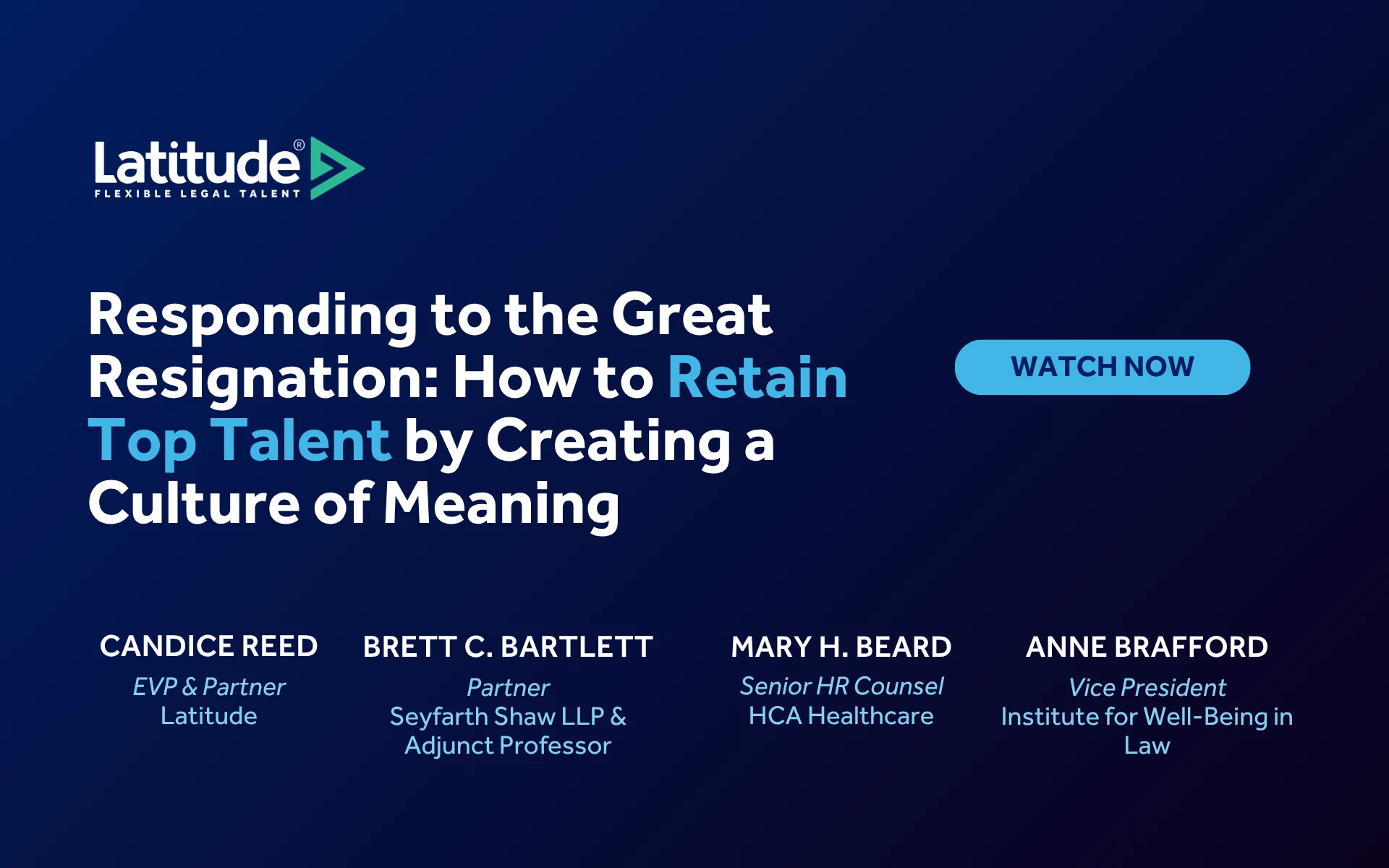
- Candice L. Reed | EVP and Partner, Latitude & Adjunct Professor (Thriving in the Law), The University of Tennessee College of Law
- Brett C. Bartlett | Partner, Seyfarth Shaw LLP & Adjunct Professor (Innovation in the Practice of Law), The University of Georgia School of Law
- Mary H. Beard | Senior HR Counsel, HCA Healthcare
- Anne Brafford | Vice President, Institute for Well-Being in Law & Former Chairperson, ABA Attorney Well-being Committee
Hi, everyone. I’d like to welcome you today to Latitude’s annual attorney well-being, CLE. We have some great guests with us today that I’d like to introduce. I’d like to introduce them more fully, but because we only have an hour together, today, I’m going to, introduce them briefly and would encourage you, to reach out to them, connect with them on LinkedIn, following this presentation if you have any questions or just want to chat with them, maybe collaborate and talk about some of the things that you’re doing or would like to do, in your legal department or law firm. So with that, we’re gonna jump right in. Oh, let me add, if you have any questions throughout the next hour, please use the chat box. I will see those as well our speakers, and we will try to get to, all of the questions that are are raised. So let’s jump right in. This is where it’s it it it gets a little clunky because I’m gonna share my screen. And here we go. So it’s like the first day of class. Just to make sure that everyone is in the right room, this is, the CLE on how to retain top talent by cultivating a culture of meaning. So today, we are gonna be talking about meaning in the law, and let me introduce you to our speakers. First, we have Brett Bartlett. He is a partner at Cyfarth Shaw. He is in the Atlanta office where he chairs, or excuse me. He’s the hiring partner. He is also the co chair of the National L and E Practice Group, and he teaches a course at the University of Georgia School of Law on innovation in the practice of law. Mary Beard is senior HR counsel at h c a HCA Healthcare in Nashville, Tennessee. She works with executives and all of the, corporations employees on training and, is a perennial favorite in the class that I teach at the University of College, University of Tennessee College of Law, where she’s been a guest speaker on, the topic of attorney well-being and finding meaning, in your individual practice. So welcome, Mary. And then we also have Anne Bradford. She is, the owner and consultant with Aspire. She also has previously served as the chairperson for the ABA well-being committee. For any of you who may be familiar, with the, toolkit that the ABA, published a couple of years ago on, creating well-being or steps towards, attorney well-being, Anne was the coauthor of that document, and she was also the chair of I believe it was the task force, right, that first kind of started to look at attorney well-being in the legal profession a few years ago. A lot of really good and important work has, come out of, the ABA’s and Anne’s leadership in this area, and so we’re very, grateful that she’s joining us today. I’ll also make a plug for the Institute for Well-being and Law, which she serves as the vice president and the vice president of programming. They have an incredible conference virtual conference coming up in January of twenty twenty two. So just right around the corner, with multiple tracks both for, law firms, for colleges of law, and for, people who are trying to create change around, the topic of attorney well-being, in a myriad of teams. So thank you, Anne. Thank you, Brett, and thank you, Mary, for joining us today. I think I included a slide on me too, when I had lighter colored hair before the pandemic. So there there you go. But, this is me. I’m the executive vice president at Latitude. I work with, managing partners and general counsel and senior, lawyers in in house all over the country. I’m based in Nashville, Tennessee, so most of my clients are here in in and around Nashville. But I also lead our, recruiting, team. And as you might imagine, we’ve been really busy this past year as a turnover among the legal industry has basically mirrored much of what we’re seeing nationwide across professions in what is now being called the great resignation. So anyway, that that that is where I sit. We’ll start today with a quote that kind of started this whole conversation. So I guess it was last month, I noticed that Anne had had put this quote from a mentor and former professor that that both of us were fortunate to learn from. Mihael Cheeksentmihalyi, on and then she, you know, suggested surmised, I wonder if this is what’s going on with the the great resignation. And so that started a conversation between the two of them that blossomed between the two of us that blossomed into this CLE. So most of us become so rigidly fixed in the ruts carved out by genetic programming and social conditioning that we ignore the options of choosing any other course of action. The moment biological or social goals are frustrated, which in the long run is inevitable, perhaps a pandemic, a person must formulate new goals and create a new flow activity for himself or herself or themself or else will always waste their energies and inner turmoil. So the question was, could this be what happened during the pandemic for so many of us that prompted this assessment or reassessment of our jobs and what we want out of work. So, Anne, since this this was the quote that you put on your social media pages to start this conversation, I’d love for you to respond to it and just tell us what you think, happened either during the pandemic or, you know, maybe alongside the pandemic, that has caused a lot of attorneys and others to, again, reevaluate what they want from work, and and and what do you think that is? You’re muted. Nicole for muted. Bingo. You know, we got it in. This is the first time I’ve done it in, like, a year, but it always happens. So the reason it it it resonated for me is because it it made me think of my own experience in law and leaving law. I think for for so many of us, we we go through law school and we get into firms where we’re just trying to achieve. Like, sort of whatever is next, whatever people are telling us is is, you know, what the what the successful people do, that’s what we do when we train our attention on that. And I came out of law school, went into a clerkship, and then went into a big firm and really was just about achievement. I just wanted to to do whatever the thing was that people were saying was successful. That was what I wanted to do. And so that’s where you get into, like, the social conditioning part of of that quote is, like, I’m just sort of tunneling about my life, and a lot of other parts of my identity might be falling off because I’m just tunneling on this one thing because I’m being kind of conditioned by my my environment to define success in this way. And then something happens that shakes that up. And for me, in part, it was, like, my age. You know, I was at the time where I had my own shakeup, I was in my early forties, and my mother was diagnosed with a terminal illness. And a thing like that just really shakes you up a bit and start reflecting on, is this what I want the rest of my life to be? And you start asking a lot of questions. And for me, that eventually led to although, like, I had a I had a wonderful time being a lawyer, I decided it was time to do something else, which really was, you know, figure out this sort of science piece of how can we bring it back to the legal profession. But that was that was my shakeup. And so the reason this quote resonated with me now is I think the pandemic is acting like that event for a lot of people, where they’re really starting to reflect on all I’ve been doing is tunneling, you know, for the past however many years of of doing what everyone else was defining as success for me. Am I happy? And also sort of getting a little taste for what life could be a little different, like being able to work from home, having more time with our families, kind of seeing a vision of something that could be different. And so I think it’s I’ve also heard the great resignation called the great reflection, which I think is is true as well. Just people are thinking about what what else can my life be and whether that’s, like, leaving another maybe not not just leaving law. I don’t think a lot of people are leaving law based on the data, but they are going into other practices just looking for change or some way to make their lives different than what they were before. Yeah. I I I think you’re right. And it’s it’s certainly something that we’re seeing a lot on on or within our business. You know, a lot of attorneys asking what the options are or, you know, maybe they’re not ready to to leave their job, but there is this reflection of is what I’m doing the way that I’m doing it really what I want to be doing. Brett, you you hire a lot a lot of attorneys and and manage a lot of attorneys as well. What do you think are some of the things that attorneys want out of work out of their work? Yeah. You know, I I frame that that thought, with something that I find myself repeating quite often when I’m talking to people about what I do for a living. I absolutely love what I do, and I have for a long time. I knew that I wanted to do labor employment work, and I’m a labor employment lawyer when I went to law school. And so falling into labor employment after law school, I had found kind of my holy grail in a sense. And then I niched myself even farther into a subspecialty of labor employment law where I got to learn the ropes and become a specialist in something that many others had not. And it really fit my personality in almost every way. The nature of the subspecialty that I was doing, the people who I was working with, the clients that I was getting to serve. And so I I think about my own experience. And and by the way, I should note, I’ve I’ve left three firms, and I always say I’ve never left a firm that I didn’t love. I’ve loved every firm where I’ve worked. I happen to think that CyFarth is the cat’s meow, and it’s the place that I’ll be forever. But as I think about my own path and how much I’ve adored what I’ve done, that’s what I want to find in the attorneys who I’m I’m talking to about hiring, whether it be a junior associate, a summer law clerk, a lateral partner hire. I’d look for in them, the aspiration to do something that they really like, that they’re jazzed about, that they’re intellectually curious about. And I think in order to retain top talent and to, first of all, attract those who are likely to be retainable, you have to find a way to relate to them with what kind of position you’re offering them, what area of law they might be practicing in, who they might serve just just as I had to think about those things too. And I think that labor employment law is indicative of kind of the way that peep attorneys can proceed through their profession. I think about some of the more senior lawyers who I’ve met over the course of my career who talk about the fact that you always have to change direction. And so the old timer labor lawyers who were dealing with the National Labor Relations Act initially, you know, they were going gangbusters. And then this thing called the Civil Rights Act of nineteen sixty four came about, and suddenly that was the area to be. And then for me, it eventually transferred into the Fair Labor Standards Act, and that was the cool thing to do. And so people kind of move as they go along. And so I’m looking for people who are willing to move, are resilient to have things change. And I think that if I can match in with what their aspirations are for that those changes, I’ll be able to retain them. So with both of you, what I hear there there are a couple of points. One is that what we want to do or what we want out of work doesn’t remain stagnant. Right? So what we wanted or what we were looking for right out of law school may not be what we need or want ten years later. So, you know, how do we get how do we stop tunneling to have these moments of reassessment, both of our careers and our priorities, to make sure that our job is, meeting our needs? And then also, Mary, I’d love for you to respond to this question. How how do people who don’t know exactly what they wanna do, you know you know, for those of us who kind of fell into law school, say, and certainly had no idea what type of law we wanted to practice, when we went into law school, how do we find that thing that we want to do, that passion that Brett talks about? And it and is it is it something that we always have to find within our own individual practices? So I will say that, we’re talking about the great resignation, and Anne called it the great, reflection, but I think it’s also I’ve heard it because the great reshuffle. And so I think we have to think about how do we move from what we know today and what we can do more. And I think that I’ve done that in my career. I give on my only my personal experience is that when I stepped into the role that I have now at HCA Healthcare, my role was senior HR counsel. And as I looked into the, legal compliance efforts of our HR organization, I found out that their contracts were, maybe not in compliant as they should be. And so as part of my practice, I kinda shuffled myself. I found that I really had an interest in, intellectual property and data privacy. And so I call myself, a honorary team member of our technology legal team. And because I work so closely on them and I actually decided that, you know what, Mary? You can do this. You can actually learn this. You can be a, because as Brett said, the law has changed. Employment lawyers are not just traditional labor and employment lawyers. We have to think about how the world is changing. And especially with employees and employment law, we’re moving towards that AI, that data privacy, that intellectual property and how we handling issues in the workplace. And so one of the things I think that you need to think about as an attorney is what are your passions. Right? So what do what area of the law do you think that your personal life goals line up with? And that’s what I did when I transferred from FedEx to ACA. I actually had a career coach, that talked to me about, Mary, what are your life passions? And so as I went through that process with her, I found out that it was health care. That’s the area of the law that I wanted to go into because it because it fit my internal passions. And so I think we need to think about what are your resources? What are the meaningful relationships that you have? Whether it’s an executive coach, whether it’s a fellow attorney, whether it’s a mentor that’s outside of the legal profession? Who can actually help you develop, that reshuffle that you think that you need so you can move forward in your career. I would also add to this, Candace, that there’s actually research on finding passion versus creating passion, and there’s both. There’s people who are able to do both. So, you know, there are people that know right out of law school or even in law school what what they wanna do, and that’s awesome. A lot of people a lot of people don’t. I also wanted to be a labor and employment lawyer. It’s funny that we all do labor and employment law. But for those I did not, just for the record. But not everyone does. And so, like, what what the research suggests on those folks, it’s that it’s a process, and it includes other people. And and I know from talking to to Brett and Mary yesterday that they help do this with the people that they work with, that the way interest is developed, like, when you don’t know what your interest is yet, is engaging with it, figuring out you have to struggle with it a little bit, but while you’re struggling with it, you have people there supporting you, helping you, rooting you on. So they help integrate you into it and help you grow. And so the idea where flow comes into this back to, you know, Mihai Taksatmihai is that one of the the optimal when when we’re experiencing an optimal experience, it typically is when we’re being stretched but not beyond our capacity. We’re not being overmatched. So when we have great mentors coming into law firms that are trying to help us create passion by showing us what’s so awesome about this, giving us opportunities to feel that we’re effective at it and to continually grow without feeling overwhelmed, that is going to start to create meaningfulness, passion where it might not have existed before. So for many of us, we probably could fit into most practice areas if we have the right people around us, you know, encouraging us and helping us learn. For some, like, there’s if anything to do with math, I probably wouldn’t have worked out in. Like, I just don’t have the innate interest or capacity, but sort of anything else, I probably would’ve very well could have loved as well. I I love the idea and the reality of how other people can help us connect with the meaning, not just identify our passions, but also connect with the meaning in our work. And we know that, meaning is not necessarily tied to the the work that that you do. You can find meaning in any job, in any work, but it’s critical that you do connect with that meaning in order, for you to have work satisfaction that then is going to lead to you know, or at least, contribute to life satisfaction and overall well-being. And I’ve heard you say that, lawyers don’t just have to rely on pro bono cases to find meaning, in the practice of law. Let’s take a quick step back and I I’d love for you to just give us a definition of meaning. I think we all kind of intuitively know what it is, but maybe don’t know how to talk about it. So, Anne, what is what is meaning? So I actually have a written definition that I don’t have with me. So I’m just gonna Wing it? Just I’m just gonna wing it because I kinda know a little bit about it. Yeah. Yeah. Mean, it is, like, most people do think when I I talk about meaningfulness a lot because it it’s important to my work. It’s important to me personally. And so most people do think that it that it’s only something sort of esoteric and up here. Like, I have to work for a public interest firm or it’s about pro bono. And those are great. And and the the part of that that creates meaningfulness is feeling like you’re having a positive impact in the world. And that is part of what you know, one dimension of how we create meaningfulness. But there are other dimensions as well, and we can create there’s there’s an idea of both meaningfulness in work, in the work itself, but there’s also meaningfulness at work, so the people around you and belonging. So this stuff about meaningfulness, like, in the work itself, it’s like, am I connecting with something that aligns with my personal values, my skills, my preferences, my talents that do develop over time and others help you connect with that? And so that’s, like, the overarching definition of of meaningfulness is that, like, I am doing something that is self congruent, that aligns with my preference preferences, strengths, and values, and I feel that I’m having an effect, a positive effect in the world. And so that can be by, like, the work the work itself of feeling like it matches who you are and you’re able to contribute to it. A sense of growth when I’m growing and people are helping me grow, that creates a strong sense of meaningfulness. And then the idea of belongingness. Do I feel like people value me that I they want my contributions. They’re requesting my contributions because I have unique skills and talents that I wanna contribute. And when people ask me for that, that creates a sense of meaningfulness. And then just, you know, a a valued part of the group that this group respects me, values me, wants me here. Like, all of those things are things that all of us kinda no matter what our the organ the kind of organization or the kind of work we’re doing, that we can work on creating those for ourselves and supporting it in creation of our teams as well to continually create the sense of meaningfulness, which changes over time as we change and grow. Mute. Yep. I got it. I know. Everybody everybody drink. So, Mary, I know that mentoring, both having mentors and mentoring others is very important to you. How do you think others can participate or help find meaning or, cultivate meaning, among their teams or with their coworkers? I think that you do it by, first, you show appreciation for each other. And why I mean show appreciation for each other, I think you have to understand and appreciate the contributions that each of your team members bring to the table. And not only that we appreciate each other, it’s that we value each other for who we are in the workplace and beyond. I think that one of the things that companies need to think about and concentrate on is that employees I’ve I’ve been a labor employment attorney for some years now. And when I train managers about how to make sure that employees have a meaningful work experience, the main thing I teach them is that they have to be appreciated. They have to be appreciated for the contributions and their sacrifices and just for who they are. And how does an employer show that or how do fellow employees show that? You do that through employee engagement surveys. You do that through recognition programs. You do that through, having well-being programs. You do that through, diversity, equity, and inclusion programs in the workplace. People want to feel that they’re appreciated kind of across the board, not only from a from a professional aspect, but in their personal, contributions, not only to the company, but also, to society. And so I think that those are some ways in which you can do that. Yeah. What’s interesting to me is that so far, no one is talking about money. And, we know that last year, their turnover among the legal profession was around ten percent, which was the highest it has ever been since we’ve started keeping track of data like that. I suspect that twenty twenty one, once it’s done and in the books, will even be higher, just anecdotally based on, you know, what I’m seeing, from my personal perspective. We also know that when people or attorneys start to leave, there tends to be, a pretty quick response by a lot of the Amlaw two hundred firms or Amlaw ten firms, to, you know, raise salaries, to to offer lucrative retention bonuses. And I don’t want to discount those, because I do think, that that, you know, being an attorney is hard work, and you should be well compensated, for it. And there, there there’s there’s room for money. So please no one hear me say I want you to make less than what you’re making right now. I want you all to make, a a very good living. But I do think it’s important to note that when we talk about meaning, when we talk about some of the best jobs we’ve ever had, some of the best employers or managers that we’ve ever had, we don’t talk about how much money we made in those positions. So, Brett, speaking, as a partner in one of those large law firms, what are you doing in addition to making sure that your attorneys are well compensated, for the work that they do to to make them stay, to create this positive culture within your firm that where people want to work there? So just as a starting point, I’ll say, I think our profession historically has been flawed. Maybe historically is the wrong word. At least in the past handful of decades, it’s been flawed in that. The way that we’ve known as lawyers, particularly at big law firms that we’re doing well is that we get an increase to our compensation at the end the year, and we might get a bonus. And particularly as one gets into the partner level, it there’s not a lot of feedback giving us pats on the back and that kind of thing. In in fact, we are our own bosses in a sense, and so you don’t have a supervisor all the time coming in saying, hey. You did a great job. So the, you know, the the soft side of the human element is missing historically from our profession, I think, because of that reward system that tells us how well we’re doing. And I think it that aligns a lot with what we see in the marketplace right now that firms are throwing money at people in order to show them that they mean something to them. You’re very talented, and therefore, I’m gonna pay you a lot of money. We we have to disassociate disassociate, I think, the human element, the performance element, the meaningfulness element from compensation. And so at CyForth and at other firms that I’ve tracked who are kind of operating in the same space with the same mindset, We’re looking at ways to engage with our lawyers in ways that help them understand that, yes, they are going to be well compensated. We’re not that far off in terms of compensation from those firms that are paying the most, but it’s the other stuff that matters. The conversation about what it is that you want to do, you know, do is litigation something that you’re into? You may be litigating cases, but being in conflict with someone every day as a matter of your practice can be hard, and it’s not for everyone. And so those ongoing conversations that we have with our professionals to talk to them about are are things working out for you in the right way? Is this what you like to do? Is there something that you like might like to do better? All of those things matter tremendously and are able to pull people out of the mindset of thinking that they’re rewarded or not rewarded with compensation. And then in addition to that, we think about how can we ensure that people feel like they’re connected to the rest of the firm, both within our department locally in Atlanta, within the office in Atlanta, and then more broadly across our platform. We have about a thousand lawyers across our platform, and it’s very easy, particularly when we’re working remotely, to lose touch. And so how do we build that cohesion that we lose because we’re not seeing each other face to face. And some of the things that we do at CyFarth, we’ve developed an initiative called CyFarth Life that focuses in on these things that disassociate us from the billable work that we’re doing. We’re doing meditation classes. We’re encouraging people to to be mindful of their environment, of their peers. We’re also doing things like, setting up what we call a Peloton pack, where we have about a hundred and thirty people who are all exercising either on Peloton bikes or using the Peloton app or doing something else, and we’re tracking the minutes that we spend doing those things. And I think all of those things, and and there’s a lot more, but all of it really kind of pulls people together and gives them a fresh way of looking at their roles. And if we can convey to people that that’s how we look at the world, it’s not just money. And if we can get them to buy into that, I think that we’ll have a happier group of lawyers, a more mindful group of lawyers, and lawyers who think that what they’re doing is meaningful. As you’re talking, Brett, I’m reminded of the advice that we would often tell our daughter when she was much younger to use your words. You know, use your words, that it’s not, that that gratitude and appreciation can’t always be in the form of a of money. That sometimes saying thank you or, as Mary mentioned earlier, engaging with perhaps a younger or lesser experienced attorney to help them, whether it’s with a particular skill or, to mentor them along their career path. Those ways of communicating can be can be the thing that keeps someone in a position, you know, if if compensation is is not an issue. I mean, I will tell you that very rarely, do I meet with candidates who say, Candace, I’m considering leaving my job because I’m not paid enough money. That that rarely happens. Now do they wanna make good money? Of course. We all do. Right? Or or most of us do. I shouldn’t speak for everyone. But most of what I hear is, either the job is no longer aligning with my, professional or personal priorities or goals. I mean, certainly, after the pandemic, there are some real logistical issues that people have had to struggle with. Right? Maybe they need more time at home or maybe now that they’ve been working from home for two years, they just want to be working from home. They don’t wanna go back to an office. You know, maybe it’s fewer hours. Maybe it’s a more, structured schedule. And then, also, it could be, I’m, you know, I’m I’m struggling to fit in. I don’t feel like this is a good fit. I hear that a lot. And I think that goes to the relationships that people are having, within within their workforce or within their work teams, and that hits on what you’re talking about. And one of kinda switching gears slightly to talk about burnout. Someone in our audience has raised the question about, you know, how we address burnout from an organizational standpoint. Many because of this re resignation, reshuffling, reflection, whatever is going on, over the last year, many people may feel like they’ve had to work longer hours. It may be harder to put boundaries around our work because we’re working from home kind of, you know, constantly on. And so, you know, there is this feeling of burnout among a lot of attorneys, and it’s not it’s not new to the post pandemic world. We’ve always experienced that. But what is that, and what can be done on a organizational level to support people who may be experiencing burnout? Yeah. It’s I totally agree with you. Like, it’s not a new concept in the legal profession, but it is really acute right now. And there are some things that have always been around that are being exacerbated right now. And, essentially, what burnout is like, a lot of people will say that they’re they’re burned out, which is which which what they’re saying is just I’m tired, which isn’t exactly what what burnout is. There is a component of emotional exhaustion, but there’s also components of lack of fit. So, you know, there’s there’s numerous factors where you’re asking, like, is this the right fit? So am I am I working so hard that I’m not able to prioritize anything else in my life so your workload gets out of balance? Are my values not matching my organization? Do I not belong in this environment? So it’s sort of the same things that we’ve been talking about. You can think of and I actually, I have a book called positive professionals that, you know, that talks about what’s the difference between engagement and burnout. Like, which how how do we make the scale go one way and not the other? And you really can think about burnout as a scale that work number of hours is only one factor. It’s an important factor, but it’s only one factor. And so there are some things that you can do about the the work hours itself, you know, or at least trying to. But other than that, what are the other kinds of resources that you can boost up? Because in some cases, it’s hard to reduce the hours. It just it is what it is right now, especially when there’s staffing shortages. So they’re dealing with, you know, job demands. It’s hard work. Maybe clients are yelling at them. There’s some hard stuff that we can’t do a lot about. It’s just part of the job. So on the other side of the scale, the the boosters part, what can we do? And there’s things like with with respect to time. If I if I can’t reduce your hours very much, can I help you manage your time better? So sort of being better about saying trying to create common understandings in your teams about we’re gonna try to shut off at x o’clock each night. If there’s an emergency, here’s how we’re going to address it. We’re gonna try to take off on on weekends if we can. Here are the circumstances under which we can’t. Trying to man like, if if you’re in a a partner or supervisor role, trying to manage your own time remembering about how what you do, how you manage your own time affects everyone else. And so when I I’ve I’ve done associate focus groups over the past year and a half. And what I they certainly talk about number of hours, but even more so, like, where I really hear the emotion is feeling disrespected in how their time is used. So saying I have to have this tomorrow. Right? And and they work all night and they get it done, and then you didn’t really need it then, you know, or requiring work on weekends when the associates don’t really think it was required. So it’s those kinds of respect issues. And and let’s say that it was important to work on the weekend, then be sure to communicate the rationale so that they then have a sense of agreement. Oh, that’s a good reason. I agree with you. I am doing this in a more voluntary way rather than just feeling compelled by others to do it. I’m sort of always trying to get them involved of understanding why you’re doing what you’re doing. And maybe, like, you you really you thought you needed it the next day, and for some reason, you couldn’t get to it. Explain that, right, rather than just leaving them thinking, I was just really disrespected. So that that’s sort of the time piece of of trying to figure out how to allow them more time to disconnect. So when that they aren’t working, they’re really not working. They’re not worried about, do I have to check my email every x minutes and and that sort of thing. And that’s what what the research shows about burnout is that’s one of the biggest factors. And there’s even some studies on lawyers showing it, that the inability to disconnect, of spillover, of always worrying about work. And so it’s a very high experience of work conflict kinda no matter what the number of hours are that you’re working because you’re always on even when you’re allegedly not working. And then, like, all the other factors that we’ve been talking about of caring leadership, right, of of of making sure that they know that you care about them, helping them develop. All of those those good things about what we do interpersonally builds up their resources so that they actually perceive stress as less of a challenge. Their perceptions actually change. Like, I feel up to the task when they feel like they’re being supported by people around them. So it’s this combination of things of, yep, there’s just some stuff about the practice of law that we can’t do about, but there are some things that we can focus on that that really is it’s more interpersonal of helping them feel that they have enough resources and support, to to meet the challenges in front of them. This will probably, seem like a shameless plug for Latitude. But to to tee off what you said, the first thing that you said about the the hours and the the necessary resources to do their job, that type of thing. Some of my favorite calls, and they’ve started probably just within the last couple of years, are those general counsel or those hiring partners who will call me and say, my team is on the verge of burnout, and I need some help. And, you know, oftentimes, it may be because there’s a specific event, like a merger, or an acquisition, and so they’re working on not just their regular day to day attorney work, but also dealing with an integration that’s taking up a lot of time. And so the general counsel may bring in, you know, a couple of lawyers to to help out during that particular event so the team doesn’t feel overwhelmed for a period of six months or so, and and then they they go away. But it’s it’s interesting to me, having been, in this industry, you know, of providing attorneys on a contract basis for the last fifteen years that people are now seeing it not just as a a staffing resource, but as a resource for retention to protecting their team and, you know, looking at attorney wellness as a need and a a gap that we can help fill. So it it’s been very fulfilling for me personally to see our services and our attorneys used in that way. Are there things that individuals can do to either beat burnout or, cultivate their own well-being. And I I think it’s very important that we talk about it from a structural or organizational standpoint, but I also know that there’s probably a bunch of people in the audience right now who are feeling not all that well and wondering, okay. What can I do individually? What’s a good first step to kind of, you know, getting on this well-being journey? Any any advice from any of you? I think you need to get in a room and play your favorite music and dance the night away. I think that Dance it out. That’s your advice? Dance it out. Dance it out. Music is just a soothing for the soul. When I was at Vanderbilt Law School, we started the a group of my classmates and I started the Vanderbilt Journal Entertainment Law and Practice. And one of the aspects of that journal was entertainment, film, music, and sports. And so with Nashville I I can say that for people in Nashville. For Nashville to be, the music city capital of the world, you know, enjoy music. And I say that as a music lover of all genres of music, from country music to bluegrass Kentucky to to rap to r and b. I love it all. And so I think that you need to understand that what brings you joy? What is that one thing? Is it is it getting a pet? Is it having is it having counseling sessions? I think we really need to be mindful of that. Is it finding that friend? Is it finding that passion, that sport that you just love? The one you might not be the best at doing, but it’s something that you enjoy. A walk in the park, we cannot take away if we look at our wellness plans that we have, walking is one of the best ways in which we can reduce stress. But I do think that we, as lawyers, have to make ourselves our priority. Because if we don’t make ourselves our priority, then we can’t give the best legal advice to our clients, and we can’t be the best, person that we wanna be to our family and our friends. And lastly, I would say that the thing that brings me most joy is just having, meaningful relationships with those that are lawyers that understand what I do, that I can count on them, and that person is someone I can truly trust with my real feelings. You know, how am I feeling today? And I can just say that one day I had such a terrible call terrible meeting. And and so I called three of my colleagues because I couldn’t get the first one. I called the second one. I called the third one. And it was amazing how all three of them called me back based on my message. I don’t know if they had family obligations. Some of were working from home that day. I could hear children in the background. But I said, hey, guy. I need to chat. I’m having a bad day. I had a bad meeting. I wanna talk about it. And and looking at the and looking at the attendees, two of the three of them are on this panel I mean, as attendees. And so it’s just having those meaningful relationships and understanding what you need as a person, I think, is is what we need to do to concentrate on. I’m happy to give a few thoughts too. I I agree with everything that Mary just said. Music is certainly a place where I go as well, whether it’s in the car or some other time. And the way I think about it, music and other things like it are a little bit like meditation and that it clears your brain and lets you recharge a little bit. I think exercise can do that as well and, you know, hobbies of all sorts. Some people golf. Some people, you know, read. I I read science fiction way too much of it in my free time. But the thing that I would offer, I think, that’s a little bit different is I think that it’s very important to find someone who has perspective to talk to. And that’s a little bit like finding the trusted folk who Mary talks about, but I I don’t know that it necessarily needs to be someone who’s in the legal profession. But thinking about the legal profession, I know now because I’ve been doing this for, you know, twenty two some odd years that there are hard times. There are busy times. There are times when you make mistakes. There are times when the other side yells at you. Sometimes when your partners yell at you or your colleagues. Sometimes, you know, your client’s yelling at you. And and it gets really hard, and the hours are long. And, I I recognize now the signs of myself when I’m approaching burnout. I start to resent small requests that are being made by friends, family, colleagues, and there are other signs that I see in myself. I’m not as crisp. I’m not as focused. And so I know to take a deep breath at that time figuratively and to step away and then come back to it because I know that it’s gonna get better. But if someone’s more junior and it’s the first crisis they’ve faced, they missed a case when writing a brief. They, you know, they they screwed up a deadline. They did something else that just is like the end of the world. I think back to a a managing partner at one of the firms that I where I worked before I got here, and I missed the case. And I briefed that we filed with the fifth circuit court of appeals, and I was devastated. And I walked into the managing partner’s office, and I thought, really, he was gonna fire me. He looks at me and he says, Brett, say you missed a case. Come on. And that kind of perspective, the realization that life would go on the next day is something that has mattered so much. And I think that, empowering our colleagues, our friends, our associates, our partners to gain that perspective by talking to someone else. And if you’re in a hard place, finding that perspective is is very important. Can I can I add the science geek perspective? I can say that everything they’ve said is science based, so I agree with all of it. And I’m also a music geek, so we’re all, like, employment lawyers who really are into music. I’m actually coming to Nashville, Mary, in a month just to come for the music. But there is like, there’s science on music showing both that it helps us reduce our stress and relax. And there’s also when we’re thinking specifically, like, what can we do about for ourselves to rejuvenate and and try to curb burnout, It is this idea that I one of the main factors was what I was talking about earlier, which is psychological detachment of being able to detach from work and turn off the thoughts of work for a while. And one of the best ways to do that is mastery activities, which both Mary and Brett both referenced, that when you’re doing stuff, especially creative stuff so in addition to, like, dancing, but also creating, like, even, like, baking, painting, drawing, like, anything of that sort, they’re among the best activities because you’re you’re in flow. You’re just focused on that activity that’s challenging you, and it it’s very rejuvenating. The other thing that that Brett mentioned is exercise, which is very good especially especially for lawyers because some of the most rejuvenating activities for people who are very cognitive in their work, this may seem counterintuitive. You might think, oh, I need to rest. I need to relax. For people who have very high cognitive jobs, actually, activity is better for rejuvenating. So doing some kind of physical activity. And the other thing that I absolutely have to mention that you all know, but I’m gonna say it, it’s like eat eat your vegetables. It’s sleep. The world looks different when you have enough sleep. Everything looks worse and harder and more negative when you don’t have enough sleep. So it’s just I mean, the the I recently just read a study on, like, psychological detachment of how do we do this. And the number one most effective thing was get enough sleep because it affects the way you see the world. So those are and I and I try to do all of them to, you know, better. I’m not a good sleeper, but but I do try to do a lot of the other things that we’ve talked about, you know, to to sometimes better, sometimes not depending on what’s going on. But those are a few things. And, also, attend the I WILL conference, and there’s all kinds of sessions on on these very issues. Yeah. And I think the important thing to hear, as you mentioned, Anne, you don’t have to do all of it. Right? Like, pick one thing and start there and notice how that makes you feel and if it helps you to feel, more positive or more relaxed or more focused, centered, then incorporate that into your routine. And then once that becomes habitual, maybe add something else. But, you know, don’t try to do all of it at once because then it can be stressful that you’re like, oh my gosh. I’m doing so much stuff to try to feel better that I’m now, you know, overwhelmed and feeling anxious about that. So kind of one one thing at a time, one step at a time. The other thing I heard all of you say was, you know, after the last couple of years, it’s okay for us to have fun. It’s okay for us to connect with other people and experience joy and just silliness sometimes. And if we can incorporate some of that into our work, even better. Right? I think it has been a heavy couple of years for most of us. And the idea of having fun or going out I know for me, I mean, I was a raging extrovert for for for forever, and now I’m like, yeah. No. I’m I’m good. My husband, a couple of weeks ago, said, let’s go out to dinner. And my response was, are people still doing that? You know, like, I thought I thought everyone just had, like, Uber or Lyft bring theirs bring DoorDash just brings the food to your door now. I didn’t realize that people were actually going out into restaurants anymore. But it does feel kinda weird right now to do some of the things that you all mentioned, to have fun, to kind of have some of that frivolity, within our work, because it has been a heavy couple of years. But you you’ve all said it’s okay. So I’m I’m hearing that that we now have permission to go out and do this. Take take whatever precautions you feel like are necessary for you and your family, obviously, but fun, it it isn’t is not off limits. So thank you for that. We have one question that I wanna make sure that we get to in the final minutes, and then I’ll leave a couple of minutes for you all to have your parting remarks. But someone has asked with some of the pivots that we have made in the last couple of years because of the pandemic, maybe that’s, you know, leaving jobs to work in a part time capacity or leaving jobs entirely. How do you think reentry is going to look for those attorneys? Are firms and legal departments going to be welcoming, people who have taken some time off over the last couple of years with open arms, or is this gonna be, you know, a a tough hill to climb? I think that they would. I I I really do, think that they would be open because that particular lawyer is probably calmer than most of us that are working now. They’ll have a sense of I think for I think it’s gonna be the other way around. I think for the actual applicant, they’re gonna be more selective in the employer that they’re looking for. I think that they’re gonna have a diff a different appreciation of what they call work, and how they want their work life to look. And I think that they’re gonna have a, it’s gonna be on it’s gonna be a process for them to really know what type of work or what type of employer that they’re looking for now based upon the flexibility and the life that they’ve had. So I think it’s going to be I think it’s gonna be a a very great time for them to be able to choose the employer of their choice. Absolutely. I’ll say from a law firm perspective, I think that the pandemic and the way that we’ve pivoted for it has opened up most lawyers’ minds and most law firms’ minds well beyond, I think, any point that they would have been without the pandemic. I think that we look at how we staff differently. We look at where people work differently. We look at the skill sets, that make a good lawyer differently. And so I think that people coming in from having not worked for a while, wanting to work in a law firm environment, I think that those law firms are going to be more willing to talk to these folks who may have taken a couple years off. And it’s I think it’s a very refreshing time for us as well. And I’ve noticed in candidates that we have people who are partners at law firms who, have decided they wanna go off track. They don’t wanna be partners anymore. And that’s a wonderful opportunity for us to get the skill set that they bring and the perspective that they bring. So I think it’s really kind of a positive time for those folks who want to reenter, the workforce. And I think that we’re seeing more and more employers legal employers embrace, some of what worked, some of what we showed work, during the pandemic. You know, the work from home arrangements, the, flexible arrangements, the part time arrangements. You know, I I’m hoping that post pandemic, we will hang on to some of the lessons that we learned and as a profession, we’ll be a little more flexible, a little more open minded, and a little a little more accommodating to what attorneys need in in in terms of some of those logistical factors, like flexibility, scheduling, and and just time generally. But but so far, I I think we’re we’re trending. I know the legal profession is sometimes slow to change, but I I I am seeing positive signs that we’ve learned something over the last couple of years and hopefully those lessons will stick. Anne, let let me start with you. Any parting remarks here, before before we leave the conversation for today? Oh, sure. Just one quick thing. Wouldn’t it be nice if we get to a point where we stop calling flexibility and accommodation as opposed to just how we work? But putting that aside. That put that on a T shirt. You could sell it for sure. Yeah. Yeah. I guess I would emphasize that I did sort of look around at the data of, like, why are people saying they’re leaving right now? And I think and work life balance was not number one. It was number two and much stronger for women than men. No surprise. But it was the so many of the ideas that we’ve been talking about, which is I want good, meaningful work. I want to feel like what I’m doing is, like, what real lawyers do, and I want to grow and develop. And so really focusing on some of those things in addition to kind of alleviating some of the stress with with time management, like, as I discussed before, I think are are some keys of trying to unlock what’s going on right now. And those shouldn’t be mutually exclusive. You should be able to have good, meaningful work that’s going to help you progress in your career. And as you’ve said, the flexibility or the boundaries that you need is not mutually exclusive. Thank you, Anne. Mary, any party were parting words from you? I think we, as attorneys, need to make sure that, we are cognitive of our own well-being. I think we need to take more time out for ourselves. I think that, again, I would say we need to keep ourselves first because it’s just very important. I think that that’s the main thing I’ve learned through the pandemic. The life is short and that we will have some hard times, some great times, some difficult times. So we don’t know when those times are gonna come. So enjoy each moment. Take care of yourself. Be the best lawyer you can be, but also be the best person you can be. Well said. Thank you. Brett, you get the last word. Great. I’ll just say that gratitude has made a really big difference in my perspective, in the practice of law. Saying I’m grateful for someone or something each day really kinda changes the way that I look at everything. And so I’ll I’ll say I’m grateful for the opportunity to speak with you guys and to everyone who joined. Oh, I’m so grateful to you too, Brett, and to you, Mary and Anne. Thank you so much, for the time and for your willingness to be candid and share your wisdom and perspective. Everyone attending, today will receive a follow-up email. There are some incredible resources that Anne has agreed to share with everyone, particularly those of you who lead teams of attorneys. I think we’ll find them very helpful. And, you’ll receive, any instructions about, you know, if you need assistance with CLE credit in states, where we may not have had this particular program accredited, then, we can assist there as well. Otherwise, we will be filing on your behalf. So thank you all, and I hope that everyone out there has a great day and, enjoys the rest of two thousand and twenty one. And here’s hoping for even better twenty twenty two. Thank you all. Bye bye. Yeah.